Beethoven’s Ninth: the night Vienna heard it
The 7 May 1824 premiere placed orchestra, chorus, soloists, conductor, and a profoundly deaf composer inside one difficult public event.
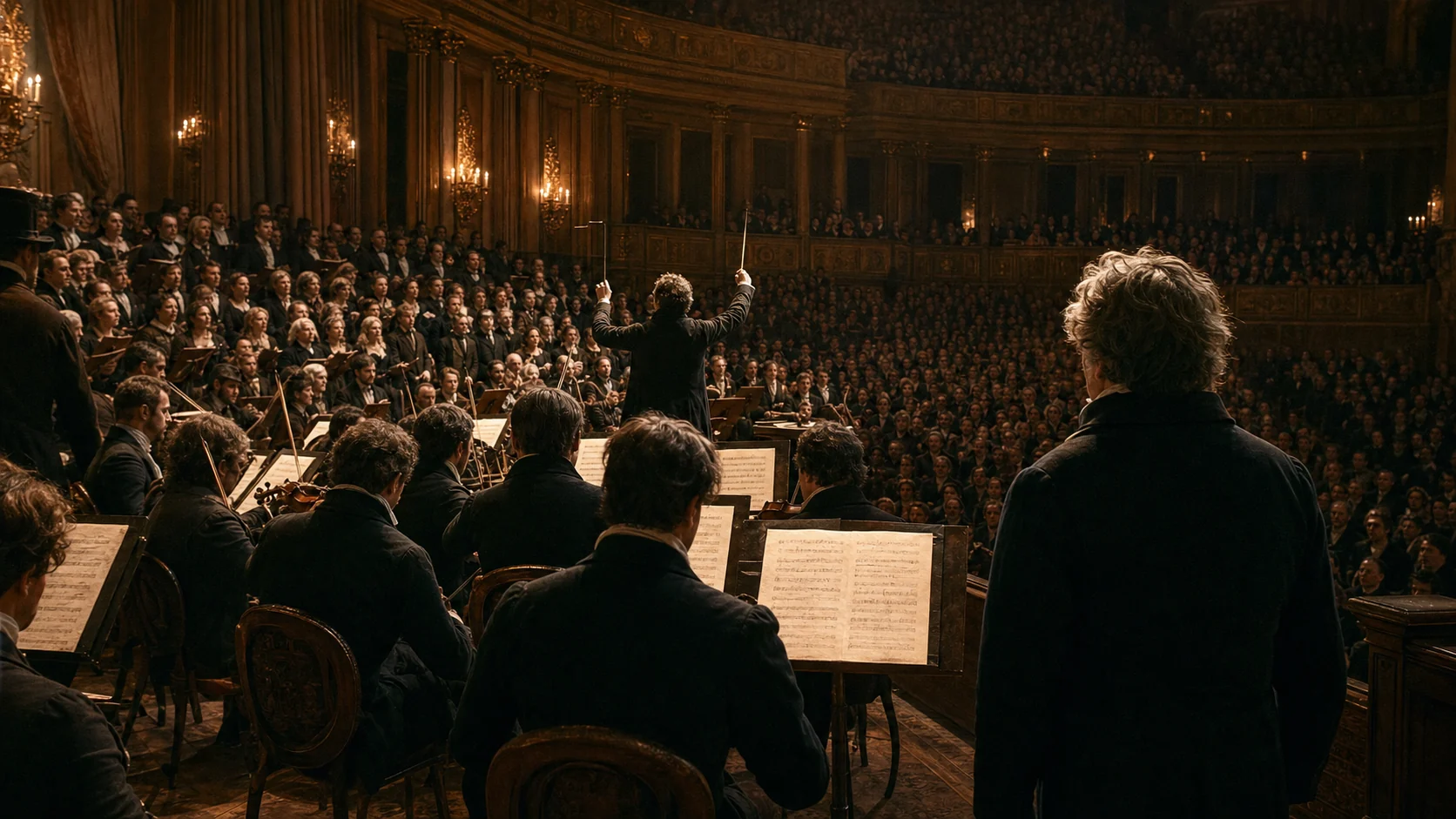
A new scale for a symphony
Beethoven’s Ninth was first performed at Vienna’s Kärntnertor Theater on 7 May 1824. Its final movement brought vocal soloists and chorus into a symphonic design on Schiller’s text, creating an event with unusual rehearsal and coordination demands.
Who led the performance
Michael Umlauf directed the musicians while Beethoven shared the stage and indicated tempos. Because the composer could no longer reliably hear the ensemble, the performers had been instructed to follow Umlauf.
The turn toward the audience
A famous account says contralto Caroline Unger turned Beethoven so he could see the audience’s response. The story survives in several retellings with differing details, but its central image captures the premiere’s tension: public acclaim reaching a composer who could not hear it.
Beethoven Ninth premiere: begin with what the record can support
On 7 May 1824, Vienna heard Beethoven’s Ninth Symphony in the Kärntnertortheater. The date, place, and programme are firmer than many details repeated about the evening. To reconstruct the Beethoven Ninth premiere responsibly, the surviving evidence must lead and the famous anecdotes must show their source limits.
The event was an “academy,” a substantial benefit-style concert built around recent Beethoven works. It placed the new symphony after the overture The Consecration of the House and three movements from the Missa solemnis. The scale of that programme matters: the Ninth did not enter the world as an isolated modern concert item.
The programme moved from ceremony to a new kind of finale
The overture opened with public grandeur. The selected mass movements brought chorus and solo voices into the evening before the symphony began. Then the Ninth’s first three movements developed an instrumental argument on a scale already demanding for players and listeners.
Its finale disrupts that path. Earlier material returns and is rejected; low strings introduce the theme later associated with “Ode to Joy”; a baritone enters with Beethoven’s own call for another, more joyful sound; soloists and chorus expand the movement into something a symphonic audience had not encountered in this form. The voices are not an ornament added at the end. Their arrival is the structural turn.
Many people had to make the score practical
Beethoven was profoundly deaf by 1824 and could not direct the ensemble through ordinary auditory control. He was present on stage and indicated tempos or character, while the practical coordination is commonly associated with theatre Kapellmeister Michael Umlauf. Accounts of exactly how authority worked differ, so the safest description allows both presence and operational direction.
The vocal soloists were Henriette Sontag, Caroline Unger, Anton Haizinger, and Joseph Seipelt. Orchestra and chorus were assembled for an unusually difficult programme, with limited rehearsal by modern standards. Rather than turning that pressure into a claim that the performance was simply chaotic or triumphant, note what the score asks: exposed entries, large forces, unfamiliar transitions, and balance between singers and instruments.
The theatre shaped what could be seen and heard
The Kärntnertortheater was an opera house, not a later symphonic hall designed around this work. Stage arrangement, sight lines, scenery, audience position, and the distribution of large forces would have influenced coordination and balance. We do not possess a recording, and a modern acoustic simulation cannot recover every material and occupancy condition.
Beethoven-Haus Bonn preserves an 1821 engraving of the stage and orchestra seating at the Kärntnertortheater. It is valuable visual evidence for the venue, but it is not a photograph of the 1824 premiere setup.
The applause story survives in several tellings
The best-known scene says Beethoven continued facing the musicians, unaware of the audience response, until Caroline Unger turned him toward the hall. The story expresses the painful divide between the composer’s public presence and his deafness. It should not be presented as if one complete contemporary transcript fixes every gesture.
Accounts agree broadly that the audience responded with unusual enthusiasm and that Beethoven needed help perceiving it. Details of who turned him, at which moment, and how many demonstrations followed have circulated through recollection and later retelling. Preserve the strong core and leave the unstable edges visible.
Premiere is not the same as finished meaning
The Ninth’s later public life includes political ceremony, protest, broadcast, European symbolism, and performances in radically different spaces. Those uses matter, but they do not belong retroactively to the Vienna audience. In 1824, listeners met a new work inside a particular programme and theatre.
Modern performance also changes what can be heard: orchestra size, instruments, tuning, chorus placement, tempo, edition, and hall all affect the result. A premiere reconstruction can illuminate choices without claiming to reproduce the night exactly. Comparison works best when the differences are named rather than hidden under “authentic.”
The surviving programme corrects modern concert memory
Modern audiences often meet the Ninth alone, after an interval, with an established orchestra that has played it before. The 1824 public first heard other recent Beethoven works and substantial choral writing on the same programme. Fatigue, expectation, tuning, personnel, and rehearsal pressure belonged to the evening.
That context changes the imagined arrival of the symphony without letting us hear it. It also warns against treating the premiere as one clean origin point. The score had a compositional history, the performers made practical decisions, and later performances quickly began another history. “Premiere” names a documented event, not the instant when the work acquired all meanings it carries today.
Use two modern recordings to hear how open the score remains. Compare the low-string recitative, the first vocal entrance, chorus balance, and the final acceleration. The differences do not recreate Vienna, but they make interpretation audible and prevent one familiar recording from becoming an imagined transcript of 1824.
What the first night changes in a later listen
Hear the finale after remembering the mass movements earlier on the programme. The human voice had already occupied the evening, yet its entrance inside a symphony still changes the work’s category and direction. Listen to the low-string recitative, the first statement of the theme, and the moment language becomes unavoidable.
Continue to Concerts for event reporting or return to the Blog index. The premiere matters not because every anecdote can be made certain, but because the documented programme, forces, room, and deaf composer on stage sharpen the risk carried by that first performance.
Keep following the subject
These pages pick up the mechanism, measurement, or source trail behind this story.