The room is the final instrument
How stone, timber, air volume, and an audience reshape what reaches the ear.
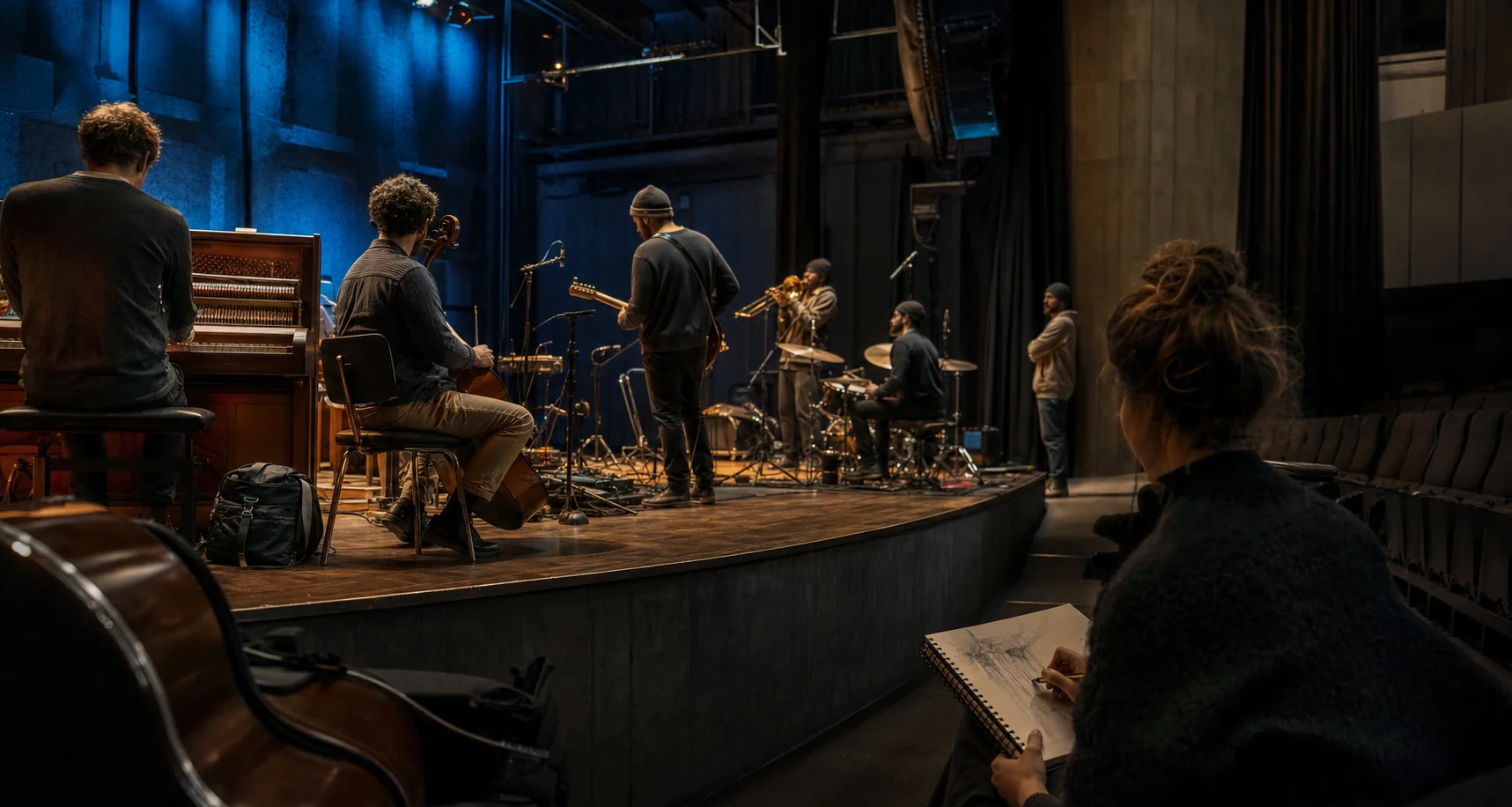
Architecture becomes acoustics
A performance space stores and returns sound. Its dimensions favor some resonances, while its surfaces absorb, scatter, or preserve different parts of the spectrum.
Clarity and bloom
Short reverberation can expose articulation and rhythm. Longer reverberation blends notes into a luminous tail. Neither is automatically better; the musical material and the instrument decide what is useful.
The audience changes the room
Bodies, clothing, seats, curtains, and open doors all change absorption. A rehearsal in an empty hall can feel materially different from the same piece before a full audience.
Room acoustics for music begin with the first reflection
A player releases a chord, but the room does not release it at the same moment. Sound reaches the listener directly, then returns from ceiling, walls, floor, balcony fronts, seats, bodies, and every surface large enough to redirect part of the wave. Those arrivals can strengthen a phrase, blur it, or make an ensemble feel larger than the stage.
Room acoustics for music is therefore not one rating called “good.” A hall can support a string chord and obscure rapid speech; it can give an organ grandeur while taking detail from percussion. The useful question is which part of the sound changed, where the listener sat, and what the music needed.
Direct sound gives the ear its first outline
The direct path is usually the shortest route from source to listener. It helps establish attack, location, articulation, and the beginning of a phrase. Early reflections arrive soon enough to fuse with that path. Depending on direction and timing, they can add apparent loudness, width, and intimacy without being heard as separate echoes.
Later reflections create reverberant decay. Their density and duration depend on room volume, geometry, surface absorption, diffusion, and the occupied audience. OpenStax describes reverberation as reflected waves reaching the ear at different times. That physical sequence explains why changing one surface or seat can alter clarity without changing the musicians.
Clarity and warmth pull in different directions
Consider a fast contrapuntal passage. The next note begins while energy from the previous one is still in the room. If the decay is long and strong, lines overlap and detail becomes harder to separate. The same persistence can enrich a sustained chorale by connecting tones and giving the harmony a surrounding field.
Words such as clarity, warmth, intimacy, brilliance, and envelopment describe perceptions, not independent knobs. A warm hall may owe part of that impression to strong low-frequency support; intimacy can involve early reflections and visual distance; brilliance can come from source, room, or both. Name the musical example before using the adjective.
The audience changes the instrument
An empty rehearsal can mislead. Upholstered seats are often designed to reduce the difference between occupied and unoccupied conditions, but people still add absorption, especially through clothing and exposed bodies. A full house can shorten or soften decay, change high-frequency balance, and alter how performers hear one another.
Stage equipment matters too. Curtains, shells, risers, music stands, scenery, an open orchestra pit, or a large projection surface can redirect energy. In a church, a congregation, seasonal decoration, and opened doors may change the room between rehearsal and service. Record those conditions instead of treating the building as acoustically fixed.
A listening walk finds what one seat hides
Play or clap the same short event from the stage and listen at several positions: close, central, under a balcony, near a side wall, and farther back. Note the attack, bass balance, apparent width, decay, and any distinct flutter or echo. Keep the source consistent. A phone recording can preserve broad contrasts, but automatic gain and stereo processing may reshape them.
For rehearsal, turn observations into actions. More separation in articulation may help where decay is long. Players may need different spacing or orientation when early reflections are weak. Amplified sound requires its own check because loudspeaker position and electronic delay create another path through the room.
Sabine’s idea is a model, not a verdict
Reverberation time is often described as the time required for sound level to decay by 60 decibels after the source stops. In the simplest Sabine relationship, that time grows with room volume and falls as total absorption increases. The model gives a useful comparison, but real rooms do not distribute absorption or sound perfectly evenly.
Modern halls may add banners, curtains, movable canopies, coupled chambers, or electronic systems to vary response. Those devices do not make one setting ideal for every programme. They let the room move between priorities. A chamber ensemble, amplified speech, and a large chorus ask different things from the same enclosure.
One room can change the hierarchy inside a piece
Imagine a singer with piano. Close to the stage, consonants and hammer attack may lead the experience; farther back, reflected energy can bind voice and instrument into one field. Neither seat is the neutral truth. Each reveals a different balance between articulation, blend, and decay.
Percussion exposes another hierarchy. A sharp attack may localize clearly while its low-frequency tail spreads through the room and covers the next entrance. Moving the instrument, changing damping, or opening more space in the part can help. Acoustic treatment is not always the first or only answer; orchestration, placement, and performance respond to the same evidence.
An outdoor comparison makes the room’s contribution obvious. Without nearby enclosing surfaces, sound can feel dry and direct, ensemble support changes, and players may ask for electronic reinforcement or a shell. The instruments did not lose resonance; the missing reflections altered what returned to performers and audience.
Write the hall as evidence
A responsible concert description names seat, ensemble, programme, occupancy, amplification, and the passage that revealed the claim. “The bass blurred” is weaker than “from beneath the balcony, the timpani tail covered the cellos’ next entrance.” The second sentence gives another listener a condition they can test.
The University of New South Wales maintains a musician-facing acoustics FAQ for further physical context. Continue to Music for close listening or return to the Blog index. The room becomes a final instrument only when the writing shows exactly how architecture reached the ear.
Keep following the subject
These pages pick up the mechanism, measurement, or source trail behind this story.