How Cavaillé-Coll made the organ symphonic
A builder portrait told through wind, mechanism, orchestral color, and three Paris instruments that changed what an organ could do.
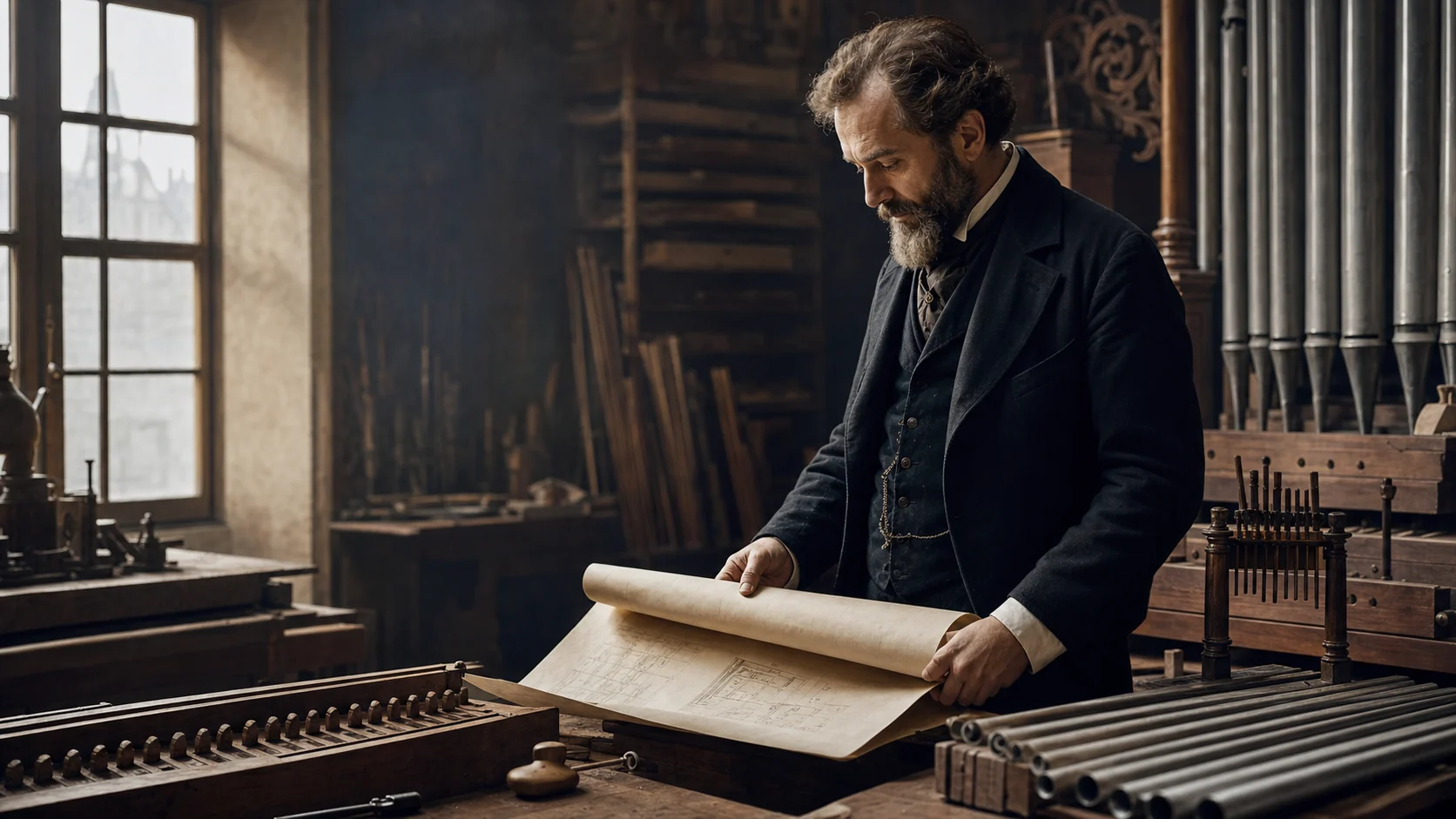
A workshop becomes a musical language
Aristide Cavaillé-Coll was born in 1811 into an organ-building family. In Paris, his workshop joined inherited craft with engineering and a close attention to the changing scale of nineteenth-century music.
Power under the player’s hands
Divided wind systems, expressive divisions, Barker-assisted action, harmonic flutes, and forceful reed choruses gave players new ways to build long crescendos and contrast whole families of color.
The instruments left behind
Saint-Denis, Sainte-Clotilde, and Saint-Sulpice preserve different chapters of the builder’s work. Their influence belongs not only to organ construction, but to Franck, Widor, Vierne, and the repertoire written for this new sound world.
Aristide Cavaillé-Coll built change into the organ
An organ chord can begin as foundations, gather flutes and strings, admit a distant expressive division, and finally draw reeds into an orchestral weight. That kind of controlled growth became central to nineteenth-century French organ language, and Aristide Cavaillé-Coll built instruments that made it unusually persuasive.
He did not invent every device associated with the symphonic organ, nor did every instrument leave his workshop with one identical plan. His achievement lay in joining wind, action, pipework, layout, and console control into a musical system that performers and composers could inhabit.
A family workshop reached Paris at the right moment
Born in 1811 into an organ-building family, Cavaillé-Coll learned the craft through work rather than from a detached theory of instruments. The family’s activity in southern France gave him practical experience with pipes, wind, mechanics, and the negotiation every commission requires between room, money, tradition, and ambition.
Paris offered larger churches, public attention, industrial resources, and a culture increasingly interested in orchestral colour. The commission for the Basilica of Saint-Denis became a decisive early opportunity. Completed in 1841, that organ established his Paris reputation and demonstrated a scale of mechanical and tonal integration that later projects could develop.
More wind required more control
Large reed choruses and varied wind pressures can make key action heavy when the player must open many pallets mechanically. Cavaillé-Coll adopted and developed pneumatic assistance, including the Barker lever, so coupled manuals and fuller registrations remained playable. The device did not remove the organist from the mechanism; it changed how large resources could be controlled from the console.
Wind systems also became part of the tonal design. Reservoirs, pressures, windchests, divisions, and couplers were arranged to support families of stops with different demands. General claims should still be checked against each specification. An organ altered by later builders may not preserve the wind or action Cavaillé-Coll supplied.
Harmonic flutes and reeds changed the palette
Overblown harmonic flutes use extra resonator length and a small hole to encourage a higher mode, producing a bright, projecting tone. Foundation stops supplied body; narrow-scaled strings added edge; reeds offered solo and ensemble colours associated with orchestral winds and brass. The point was not literal imitation, but contrast that could blend.
Families mattered more than isolated novelty. A flute could emerge from a softer background, an oboe-like reed could carry a line, and foundations could accumulate beneath a crescendo. Enclosed divisions and swell shutters allowed some of those colours to grow and recede after the pipes had begun speaking.
Three Paris instruments show different problems
Saint-Denis announced the young builder on a major scale. Sainte-Clotilde, completed in 1859, became inseparable from César Franck’s work as organist and composer. Saint-Sulpice, inaugurated in 1862 after retaining substantial earlier pipework, demanded a different act: transformation on a vast site rather than replacement without memory.
Those organs should not be flattened into one “Cavaillé-Coll sound.” Room, inherited material, stop list, wind, later restoration, and liturgical use differ. The Philharmonie de Paris account of César Franck at Sainte-Clotilde connects a specific instrument with the works Franck composed during his tenure.
Composers learned to think in registration and time
Franck, Widor, Guilmant, Vierne, and later French organ culture encountered instruments capable of sustained tonal architecture. Registration could behave like orchestration: a solo against accompaniment, dialogue between manuals, a reed chorus arriving over foundations, or a long crescendo shaped by coupling and swell.
The relationship was not one-way. Organists demonstrated instruments, advised, criticized, and composed around what consoles made practical. Builders responded to rooms and performers. Calling the organ “symphonic” describes this expanded musical language more usefully than claiming that it simply copied an orchestra.
Saint-Sulpice shows how innovation could include inheritance
The Saint-Sulpice project retained significant earlier pipework while reorganizing the instrument on a new scale. That choice complicates the idea of a builder’s organ as a single authored object. Old material, new mechanisms, revised wind, and later maintenance coexist inside the case.
Listen and write accordingly. A surviving stop may contain older pipes but speak through a system shaped by Cavaillé-Coll and subsequent restorers. Attribution needs levels: pipework, stop, windchest, action, console, disposition, and voicing history. The famous name on the organ cannot settle every layer by itself.
Documents and restorations decide what survives
A current visit is not direct access to the nineteenth century. Pipes may be revoiced, wind pressures changed, actions rebuilt, consoles replaced, pitch altered, and rooms modified. Restoration can preserve, recover, reinterpret, or overwrite. State which intervention and date support a claim about present sound.
Specifications, contracts, workshop correspondence, inscriptions, pipe markings, photographs, and measured construction all serve different roles. A stop list proves names and disposition at one documentary stage; it does not alone prove voicing, wind, or current condition. Missing evidence should remain missing.
The symphonic idea is a way of hearing relationships
Listen for transition rather than a catalogue of colours. How does a foundation accept a reed? Does the enclosed division seem distant or merely quieter? Can the bass support increasing brilliance without losing definition? Those questions reveal the builder’s system more clearly than one loud tutti.
Continue to People for maker and performer stories or return to the Blog index. Aristide Cavaillé-Coll matters because mechanical scale and tonal imagination became one playable architecture, while every surviving organ still asks to be read as its own historical object.
A short source trail
Readers who want to continue beyond this essay can compare the Association Aristide Cavaillé-Coll biography, the Musée d’Orsay authority record, and the Philharmonie de Paris material linked above. Each source answers a different question: the builder’s career, his public identity, and the musical world around the instruments.
Keep following the subject
These pages pick up the mechanism, measurement, or source trail behind this story.