Pipe organ guide: from wind to room
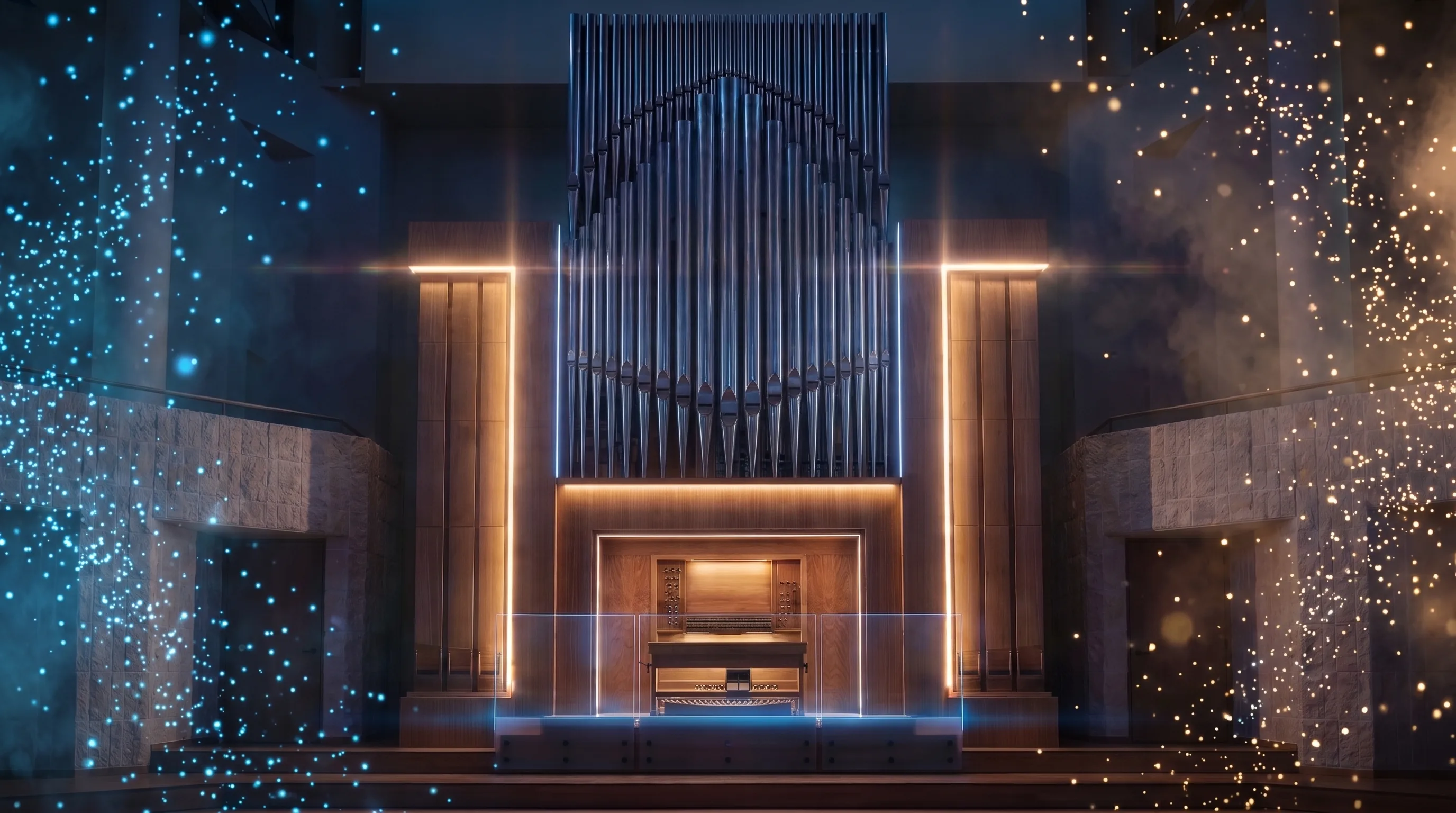
A pipe organ is a wind instrument, a keyboard system, and part of a building. This pipe organ guide traces stored wind through valve and pipe into the room, then considers registration, service boundaries, repertoire, history, and documentation.
Wind, chests, pipes, and the room
The mechanism begins with wind because every stop depends on stable pressure and a clear path into the chosen pipe. Console commands, action, windchests, ranks, and the room form one chain. A fault or design choice at any point can change speech, balance, and the player's sense of control.
Wind supply. Bellows or a blower charge reservoirs that store and regulate air before notes are played. Trunks carry wind toward chests, where pressure must remain stable as demand changes. Leaks, weak regulation, or undersized channels can alter attack and pitch behavior. Wind pressure is a design parameter, not a volume knob for casual adjustment.
Windchest and valves. A windchest distributes air beneath groups of pipes and contains valves controlled by keys and stops. Slider, pallet, unit, and electro-pneumatic systems organize that task in different ways. A cipher can occur when a valve fails to close and one pipe continues sounding. Internal diagnosis requires knowledge of the specific action and safe access.
Pipes and ranks. One pipe normally supplies one pitch and timbre at a time, while a rank extends that color across the compass. Flue pipes divide air at a mouth; reed pipes use a vibrating tongue and resonator. Scale, material, construction, wind, and voicing shape speech and spectrum together. Footage labels describe pitch relationship, not an exact universal physical length.
Stops and couplers. Stops admit ranks or derived resources, and couplers connect manuals or pedals across divisions. A stop name suggests a tonal role but does not guarantee identical sound between organs. Combination systems store stop selections so players can change color quickly. Registration must be judged in the room rather than copied blindly from another instrument.
Console and action. Manuals, pedalboard, stop controls, expression shoes, pistons, and indicators form the player's command surface. Mechanical action transmits motion directly, while electric systems send commands through contacts and magnets. Key resistance and response vary with design, coupling, condition, and wind demand. Console feel can reveal a concern but cannot identify its cause alone.
Room and placement. Pipe placement, case openings, chambers, balconies, screens, and reflective surfaces shape projection. Reverberation can join tones beautifully while also blurring fast release and dense harmony. Listeners in different seats may hear very different balances among divisions. An organ assessment therefore includes the building and the occupied listening area.
| Organ system | Function in the organ | Listening or service question |
|---|
| Wind system | Stores and regulates air | Reservoirs, trunks, pressure stability |
| Action | Carries commands | Mechanical, pneumatic, electric, digital |
| Windchest | Routes wind to pipes | Valves, channels, sliders or unit systems |
| Rank | Extends one tone color | Pipework across the compass |
| Stop and coupler | Selects and combines resources | Registration and division control |
| Room | Completes projection | Placement, reflection, reverberation |
Playing and critical listening
Playing an organ means shaping time as much as selecting color. This pipe organ guide treats registration, articulation, release, ensemble balance, and room response as connected skills. The player cannot alter a sustained pipe tone with touch after speech begins, so preparation and timing carry unusual weight.
Registration by function. Begin with the role of each line before choosing stop names. A melody, accompaniment, bass, or inner voice asks for a distinct balance and attack. Add color in small steps and listen from the room when possible. A visually impressive stop list does not replace a clear musical hierarchy.
Articulation and release. Pipe speech begins after a valve opens and ends when wind is cut off. Room reverberation continues after the key rises, so written rests may need audible planning. Repeated notes depend on clean release as much as on attack. Practice at the instrument instead of assuming piano articulation transfers unchanged.
Manual and pedal coordination. Feet carry bass lines, anchors, and independent counterpoint while hands divide across manuals. Bench height and distance affect ankle motion, balance, and freedom of the knees. Couplers can simplify or complicate texture depending on the registration. Physical setup should support relaxed reach rather than force a fixed posture.
Listening beyond the bench. The console position may hide the real balance, especially when divisions are distant or enclosed. Record a rehearsal, ask a trusted listener, or walk the room during another player's test. Compare clarity, bass presence, solo projection, and release from several locations. Microphone placement adds another perspective but is not the same as audience hearing.
Ensemble and accompaniment. Organists must follow breath, diction, bow, and conductor gesture while managing delayed room response. A sustaining instrument can cover consonants or inner lines even at modest apparent volume. Choose registrations that leave space rather than competing for every frequency. Coordination improves when singers and players rehearse releases in the actual acoustic.
- Listen to attack and release from the room, not only at the console.
- Build registrations by musical function and add ranks gradually.
- Rehearse rests and final releases in the real reverberation.
- Check ensemble balance with singers or instrumentalists present.
- Record console settings and listening position when comparing.
Care, maintenance, and safe boundaries
Routine care stops well before casual repair. Dusting a console surface and reporting a cipher are ordinary responsibilities; entering chambers, moving pipes, tuning, regulating action, or disturbing historic material belongs to trained organ technicians and conservators.
Console habits. Use clean hands, keep liquids away, and avoid placing loose objects where they can enter pedal or key mechanisms. Report intermittent contacts, sticking keys, dead notes, and unexpected stop behavior with dates. Do not spray cleaner into gaps, switches, or stop controls. Simple observations give the technician a more useful starting point than improvised repair.
Temperature and tuning. Pipe pitch responds to temperature, and divisions in different locations may warm at different rates. Tune work is best scheduled under conditions close to normal use. Heating changes during a service can make a stable result impossible. Players should document conditions rather than moving tuning devices themselves.
Pipes and chambers. Metal pipes dent easily and wooden pipes may have fragile caps, stoppers, or historic surfaces. Walking boards, ladders, electrical equipment, dust, and tight clearances create additional risk. Never use a pipe chamber as general storage. Access should be limited to authorized people familiar with the layout.
Service records. Keep tuning reports, contracts, stop lists, photographs, invoices, alterations, and technician notes together. Record which materials were replaced and which historic parts were retained. A dated service history supports conservation and future diagnosis. Unverified stories should remain labeled as recollection rather than fact.
- Keep liquids and aerosol cleaners away from console openings.
- Do not enter chambers, move pipes, or tune without authorization.
- Report ciphers and electrical smells promptly and switch off only under local procedure.
- Maintain dated service and alteration records.
- Schedule specialist work under stable, representative room conditions.
History and evolution
For broad orientation, the history below uses the history of the pipe organ. The Met's account of conserving its 1830 Appleton organ supplies a documented example. The dates describe particular developments, not a single straight line of progress.
Ancient hydraulis. Ctesibius of Alexandria is associated with the hydraulis in the third century BCE. Water pressure helped regulate wind in this early keyboard-controlled pipe instrument. Roman examples and depictions show that organs entered public and ceremonial life. The ancient instrument was not a modern church organ in miniature.
Medieval adoption. Organs became established in western European churches during the medieval period. Large instruments gradually joined smaller portative and positive forms with different roles. Keyboard, wind, and pipe technology changed across regions rather than on one schedule. Sparse evidence should not be turned into a precise universal timeline.
Renaissance and Baroque growth. By the sixteenth through eighteenth centuries, regional schools developed distinctive cases, divisions, stops, and actions. Composers wrote with local instruments and liturgical practices in mind. North German, Italian, Iberian, French, and English traditions cannot be collapsed into one specification. Historic repertoire gains clarity when its intended resources are understood.
Nineteenth-century mechanisms. Industrial production, pneumatic assistance, electric control, and new tonal ideals expanded organ scale and console distance. The Barker lever, developed in the 1830s, assisted heavy mechanical actions. Builders pursued orchestral color, crescendo control, and larger wind systems. These changes added possibilities while altering touch and maintenance needs.
Theater and civic organs. Early twentieth-century theater organs used unification, higher wind, percussion, and effects for silent-film accompaniment. Civic and concert-hall instruments served recitals, ceremonies, education, and orchestral repertoire. Broadcasting carried organ sound beyond the building. Each branch developed its own expectations for control, color, and preservation.
Restoration and new building. Later twentieth-century work included historic restoration, eclectic rebuilding, neo-Baroque design, and renewed mechanical action. Conservation asks what evidence survives before deciding what to change. New organs continue to respond to architecture, repertoire, budgets, and institutions. A project should be judged against its stated aims and documented history.
Repertoire and musical context
Organ music reaches across worship, concerts, teaching, improvisation, silent-film practice, and collaboration. The Martin Ott Organ Archive shows how individual projects join mechanism, room, institution, and builder history, while the Instrument Atlas places the organ beside other ways of making sound.
Liturgical practice. Organs support congregational song, choirs, voluntaries, improvisation, and ceremonial movement across many traditions. Registration must respect voices, language, room, and local practice. Service playing rewards reliability and attentive pacing as much as solo display. The same instrument may require very different colors within one event.
Concert repertoire. Bach, Buxtehude, Couperin, Franck, Widor, Messiaen, and many others wrote within distinct organ cultures. A program can reveal contrapuntal clarity, symphonic build, color, or rhythmic precision. Transcriptions and contemporary works expand the instrument beyond inherited schools. Repertoire choice should acknowledge the actual organ rather than force every style.
Improvisation and collaboration. Improvisation can introduce hymns, accompany actions, shape transitions, or form a complete recital. Organ joins brass, orchestra, percussion, electronics, and voices in varied settings. Large acoustics demand clear cues and rehearsed releases. Collaboration turns registration into an ensemble decision.
Buying, documentation, and inspection
Start an organ inspection with records and listening before anyone removes a panel. Ask what was built, moved, enlarged, replaced, or prepared for later work. Then compare documents with the console, visible pipework, room, and a technician's measured findings.
Identity and provenance. Confirm builder, date, opus number, original institution, relocations, and major rebuilds from documents. Compare plaques and console labels with contracts, archives, and independent institutional records. Distinguish an original instrument from a later organ reusing selected material. A famous name without traceable evidence is not provenance.
Stop list and pipework. Compare the published stop list with controls and visible ranks, noting prepared, borrowed, extended, or missing resources. Ask which pipes are original, replaced, revoiced, or from another maker. Do not move pipes merely to verify a mark. A technician can document internal evidence safely.
Wind and action condition. Listen for slow speech, ciphers, wind sag, noise, uneven touch, and unreliable controls. Test methodically across divisions, couplers, pistons, shoes, and pedals with permission. One symptom can have several mechanical or electrical causes. Estimate repair only after qualified inspection.
Room and alterations. Document chamber openings, case position, screens, flooring, seating changes, HVAC, and nearby construction. A building renovation can alter balance without changing a pipe. Compare several listening positions and normal occupancy conditions. Acoustic conclusions should state where and how listening occurred.
Planning and ownership. Ask who maintains the organ, how often it is used, what records exist, and what work is proposed. Separate urgent reliability needs from tonal preference and long-term conservation. Clarify access, safety, insurance, and decision authority before inspection. A realistic plan includes the institution as well as the mechanism.
| Area | Method | Concern |
|---|
| Provenance | Contracts, plaques, archives | Unverified builder or date |
| Pipework | Stop list and sample documentation | Mixed material without records |
| Wind and action | Full functional test | Ciphers, leaks, unreliable contacts |
| Console | Keys, stops, pistons, shoes, pedals | Dead notes or inconsistent command |
| Building | Case, chambers, HVAC, surfaces | Alterations that changed projection |
- Which builder, date, and alterations can documents support?
- What action and wind systems are present, and who services them?
- Which ranks or components are original, reused, replaced, or prepared?
- How did building changes affect placement and projection?
- What reliability, conservation, and musical goals guide the next work?
How to make an organ listening note that another person can use
An organ test begins with the building. Write whether the room is empty, occupied, heated, or still changing temperature. Note where the console sits and where the listener stands. A division in a chamber can reach the nave later and with a different balance than it has at the bench. Record the exact stop names, pitches, couplers, expression position, and combination piston used. "Full organ sounded weak" is almost impossible to reproduce. "Great 8-foot principal with Swell coupled, shutters open, heard ten rows from the case" gives the next player a real starting point.
Use a short musical figure instead of a held chord for every comparison. A rising scale exposes speech and regulation; repeated notes reveal release; a chord held under a moving pedal line tests wind demand. Keep the figure within a comfortable key and register so technique does not dominate the result. Play it twice at the same touch before changing a stop. Mechanical actions, electric contacts, and pneumatic assistance respond differently, so describe what the key and sound do without assigning a cause from the console.
Console hearing can be deceptive. The player may sit beneath a distant division, behind a case, or close to noisy action. Ask a second person to listen near the center of the occupied area. The listener should describe melody projection, bass weight, clarity of inner lines, and the length of the release. A phone recording is useful for remembering broad balance, though automatic gain control can flatten crescendos and exaggerate room noise. Save the seat and microphone position with the file.
Wind behavior deserves a controlled musical load. Start with one uncoupled division and a moderate registration. Add couplers or lower-pitched ranks in one step, then repeat the same chord pattern. Listen for pitch sag, delayed speech, unstable attack, or a sudden change in tremulant depth. These observations do not identify a leaking reservoir or trunk. They show the conditions under which the symptom appears. Stop if the instrument behaves erratically, and give the technician the division, notes, stops, duration, and recent work history.
Registration notes should describe function before color. Name the solo line, accompaniment, bass, and room requirement. A bright chorus that is thrilling alone may mask consonants under a choir. A soft reed can carry better than several flutes because its upper partials remain distinct at distance. Compare the intended passage from the nave and remove one resource at a time. The useful decision is often a smaller combination with cleaner release, not the largest possible stop count.
Frequently asked questions
How many pipes does a pipe organ have?
There is no standard total. A small continuo may have a few ranks, while a large concert or cathedral instrument can have thousands of pipes. Count resources from the documented specification rather than estimating from the facade.
Are facade pipes always sounding pipes?
Many facades contain speaking pipes, but some include non-speaking display pipes or only part of a rank. Internal documentation and inspection are needed before assigning a tonal function from appearance.
What does an eight-foot stop mean?
Eight-foot indicates the normal unison pitch relationship at the keyboard. It comes from historical pipe-length convention, but individual pipes and stopped constructions do not all measure exactly eight feet.
Can a pipe organ guide teach registration for every organ?
A pipe organ guide can explain principles, but stop names, scaling, room, action, and voicing differ. Build the desired function on the actual instrument and listen from the room.
How often should an organ be tuned?
Intervals depend on use, climate, building conditions, instrument design, and institutional expectations. A qualified technician should recommend a schedule after seeing how temperature and condition affect that specific organ.
Is mechanical action always historically better?
No single action is universally best. Mechanical, pneumatic, electric, and combined systems reflect different dates, scales, layouts, and aims. Condition and design quality matter more than a slogan.
What should an archive record preserve?
Keep contracts, stop lists, dates, locations, photographs, service reports, alterations, recordings, and named sources. Separate measured fact, documentary evidence, and oral recollection so later readers can judge each claim.
Conclusion
A good instrument account joins wind, mechanism, pipework, console, room, player, and institution. Listen carefully, preserve records, and ask a technician to investigate what cannot be seen safely. The organ's value lies not only in scale, but in the specific history and acoustic relationship that make one installation unlike another.