From pickup to loudspeaker
A readable signal path through magnetism, voltage, distortion, and air.
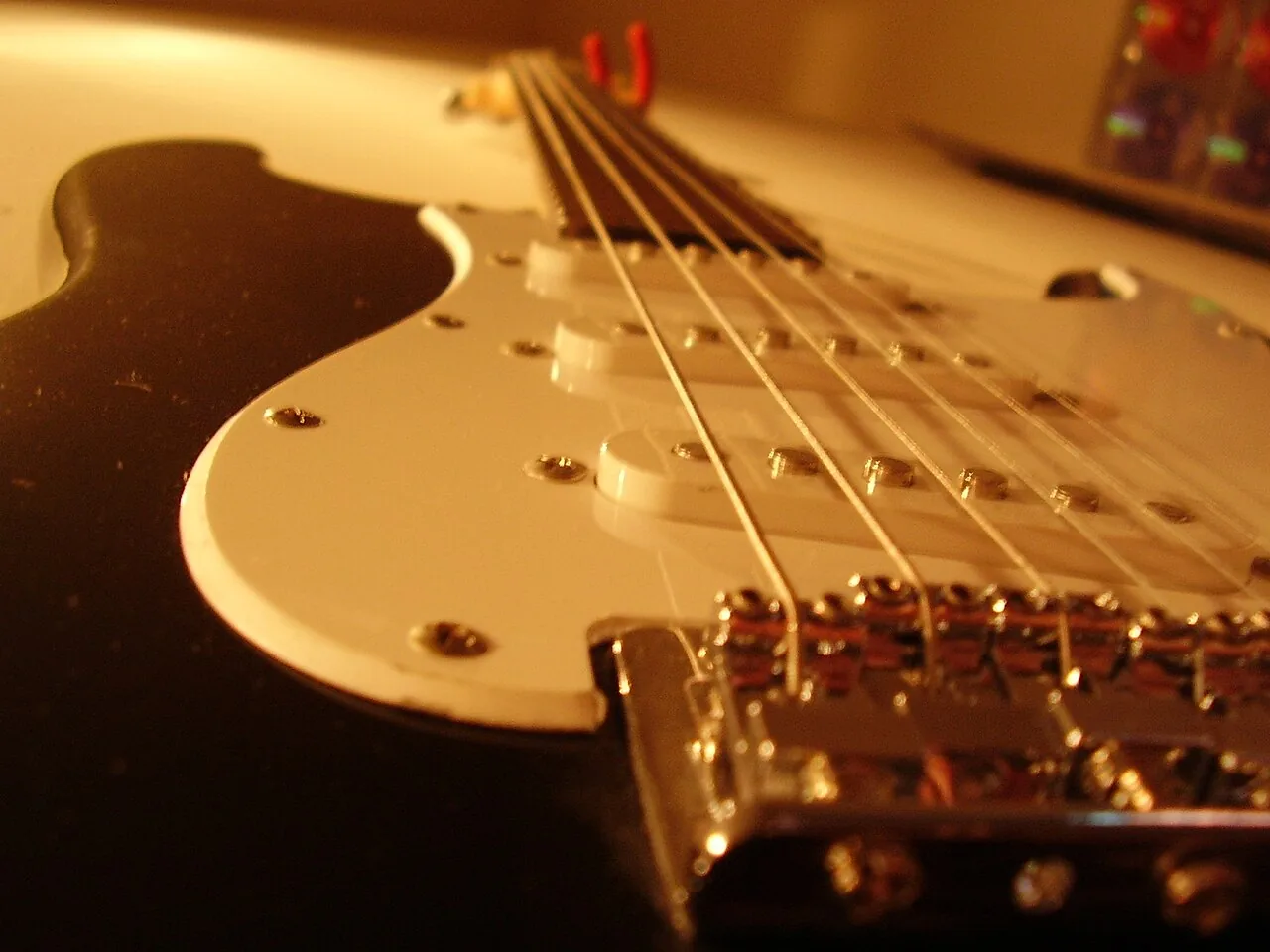
The pickup translates
A ferromagnetic string moving through a pickup’s magnetic field induces a small electrical signal. Position and construction determine which parts of the string’s motion are emphasized.
The circuit reshapes
Volume, tone controls, pedals, preamps, and amplifiers change level and spectrum. Distortion is not merely damage: controlled nonlinearity adds harmonics and alters playing response.
Electric becomes acoustic again
The loudspeaker converts current into cone motion. Cabinet design and the room complete the journey, turning the signal back into pressure waves for the listener.
The electric guitar signal chain begins before the cable
A steel string moves through a pickup’s magnetic field. That movement changes magnetic flux through a coil, inducing a small alternating voltage. The signal already contains the string’s pitch, vibration shape, position over the pickup, and interaction with the guitar before it reaches a pedal or amplifier.
The electric guitar signal chain then reshapes that voltage through controls, cable, effects, preamplifier, power stage, loudspeaker, cabinet, room, and microphone. Following the path in order turns a vague “bad tone” into a series of testable stages.
The pickup converts motion, not sound pressure
A common passive magnetic pickup uses pole pieces or a bar magnet and many turns of wire. The ferromagnetic string disturbs the magnetic system as it vibrates, and electromagnetic induction produces the output. OpenStax explains the underlying relationship between changing magnetic flux and induced voltage.
Pickup position matters because the string does not move equally along its length. Near the bridge, displacement is smaller and upper harmonic balance differs; nearer the neck, motion is broader and the result is often fuller. Construction, aperture, inductance, resistance, magnet, string, height, and loading all contribute. “Hotter” output is not a complete tonal description.
Volume, tone, and cable form one loaded circuit
Passive controls do more than reduce a finished signal. Pickup inductance, resistance, potentiometer values, tone capacitor, cable capacitance, and the next device’s input impedance form a frequency-dependent load. A long high-capacitance cable can lower or soften the resonant peak before any pedal is switched on.
That is why a guitar can sound brighter into a short cable and high-impedance input than through a long run or unsuitable input. A buffer changes the relationship by presenting a high input impedance to the pickup and driving the following cable from a lower output impedance. Placement before or after a vintage fuzz can alter the result because some circuits expect direct pickup interaction.
Pedal order changes which signal each process receives
A compressor before distortion changes how hard the distortion is driven; after distortion it controls an already compressed and harmonically rich signal. Wah before fuzz filters the source entering the nonlinear stage; after fuzz it sweeps the new harmonics. Delay before heavy distortion repeats a cleaner signal that is then saturated, while delay after distortion repeats the finished distorted event.
There is no universal correct order, but there is a clear causal order. Ask which process should react to which earlier one. Match bypass and active levels when comparing. A louder setting often appears better for a few seconds and can hide noise, lost attack, or a changed frequency balance.
Gain staging decides where colour and noise accumulate
Every active stage has an input range, noise floor, and maximum level. Too little signal early may require later gain that raises hiss. Too much can clip a stage unintentionally. Intentional overdrive is still gain staging: the player chooses which stage clips, how hard, and what signal reaches it.
Start clean with moderate levels. Add one pedal, match its output, and listen for attack, sustain, noise, and frequency change. Continue stage by stage. If the board becomes noisy, remove half the chain and test again. Binary isolation finds a failing cable, power supply, or pedal faster than adjusting every control.
The amplifier is more than one volume knob
The preamplifier raises and shapes the instrument signal; tone controls and channel stages may add drive. A phase inverter and power stage drive the loudspeaker, with circuit details varying by amplifier. In valve designs, output transformers match the power stage to the speaker load. Never treat an amplifier’s internal high voltage as a user-serviceable tone control.
Master volume and preamp gain can place distortion in different parts of the circuit. Power-stage behavior also depends on speaker load and output level. A load mismatch or disconnected speaker can damage some amplifiers. Follow the manufacturer’s impedance and connection instructions rather than assuming every cabinet socket is interchangeable.
The loudspeaker turns current into moving air
Current through the voice coil interacts with a magnetic field, moving cone and suspension. The speaker is deliberately coloured: its mass, stiffness, breakup, efficiency, and limited bandwidth shape electric-guitar sound. The cabinet changes loading, low-frequency behavior, direction, and interaction between drivers.
A microphone captures that acoustic result from one point. Move it from dust cap toward cone edge, change distance, or tilt its axis and the recorded balance changes. The room adds reflections. A line output, reactive load, cabinet simulation, real speaker, and microphone are related routes, not automatically equivalent copies.
Troubleshoot from the first confirmed stage
- Turn levels down and confirm the guitar alone with one known cable.
- Check selector, controls, jack, and battery if the guitar has active electronics.
- Add the first pedal with a known power source, then one connection at a time.
- Test amplifier input and channel before reconnecting the full board.
- Confirm speaker cable, impedance, and cabinet connection without opening the amplifier.
Instrument cable and speaker cable serve different loads and should not be substituted casually. Crackle that follows a plug points somewhere different from hum that changes when the strings are touched. Stop if there is heat, burning smell, smoke, repeated fuse failure, electric shock, or unstable mains behavior.
The chain ends in a room and a musical choice
A signal can measure clean at every electrical point and still fail the arrangement. Too much low end may mask bass; long delay can cover a vocal; a bright solo setting may become thin once the band enters. Return the repaired chain to the music and judge it at working level from the audience or microphone position.
Continue to Instruments for object and mechanism stories or return to the Blog index. The chain becomes understandable when each transformation is heard as a cause with a location, not as one mysterious tone produced by the final amplifier knob.
Keep following the subject
These pages pick up the mechanism, measurement, or source trail behind this story.