Electric guitar guide: from string to speaker
An electric guitar is a playable chain of string, fret, bridge, pickup, cable, amplifier, speaker, effects, hands, and room. This electric guitar guide follows that chain through setup, listening, maintenance, documented history, musical context, and inspection.
Strings, pickups, circuits, and speakers
The mechanism starts at the vibrating string and ends when a loudspeaker moves air. Magnetic pickups sense changes in a field; controls and cables shape the electrical load; amplifiers and effects change level and spectrum. Every stage can alter touch and noise.
String and scale. Pitch depends on speaking length, tension, and mass per unit length between nut and saddle. Scale length affects required tension for a chosen string and pitch. Frets divide that length into semitone positions under equal-tempered design. Real intonation also reflects string stiffness, action, and playing pressure.
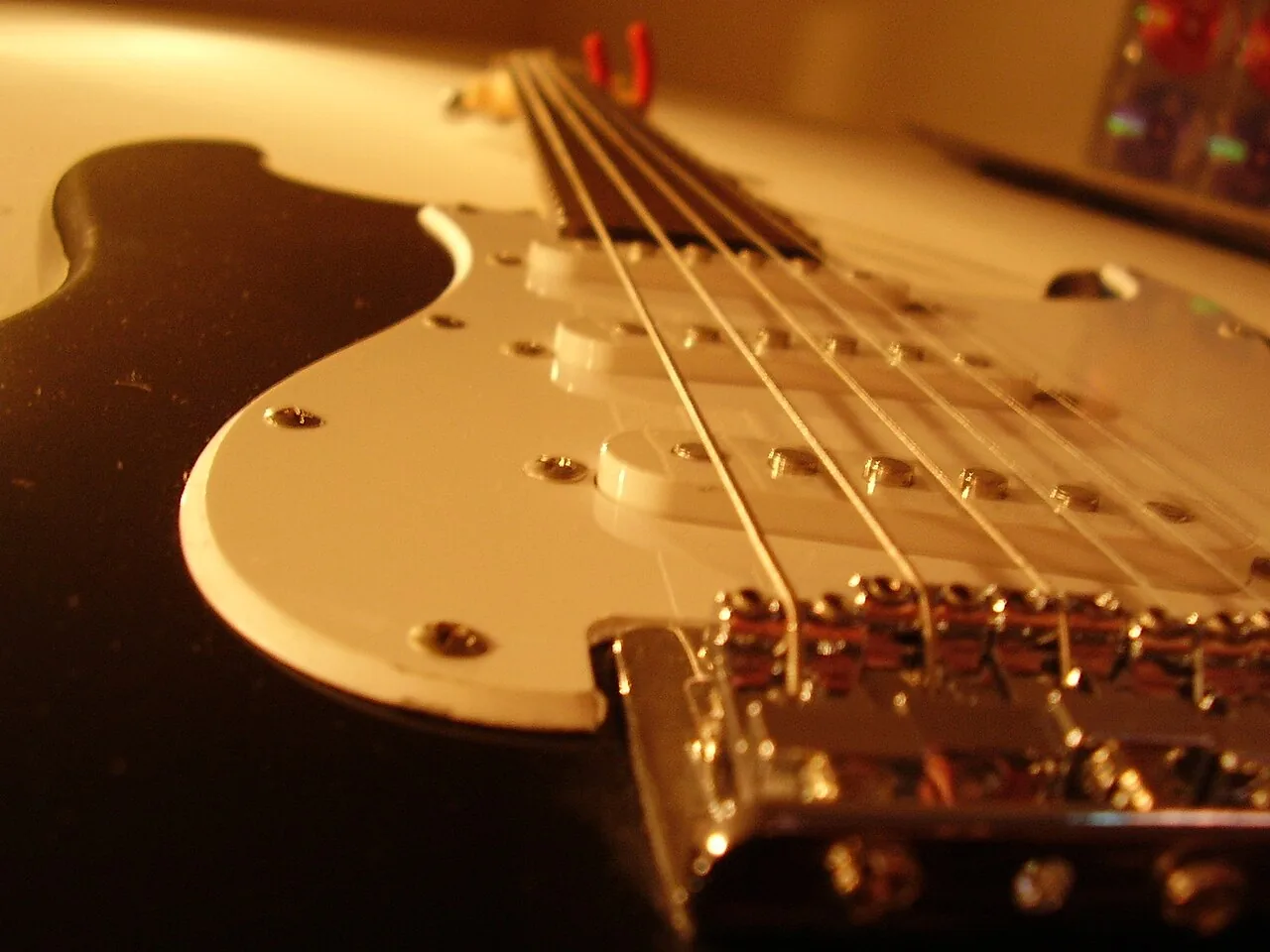
Magnetic pickup. A magnetic pickup surrounds magnetized string motion with a coil that generates a changing electrical signal. Position near bridge or neck samples a different pattern of string vibration. Coil design, magnet, loading, and height affect level and spectrum. Non-ferromagnetic strings will not drive a conventional magnetic pickup effectively.
Bridge and nut. The bridge and nut define endpoints, spacing, break angle, and practical tuning behavior. Fixed, vibrato, and tune-o-matic systems solve adjustment differently. Poor slots or loose hardware can create binding, sitar-like noise, or unstable return. Cutting and geometry work belong to proper tools and experience.
Frets and fingerboard. Frets shorten the speaking string while the fingerboard supports hand position and bending. Wear can create buzz, choking, or local intonation trouble. Relief and action influence how much clearance a vibrating string has. Fret leveling or replacement should follow diagnosis, not conceal another setup fault.
Controls and loading. Volume and tone controls form a passive network with pickups, cable capacitance, and amplifier input. Turning volume down can change high-frequency response depending on circuit design. Switches combine or select pickups with different phase and coil arrangements. Scratchy noise may come from contamination, wear, grounding, or a cable rather than one pot.
Amplifier and speaker. A guitar amplifier raises signal level and may add intentional nonlinear response, equalization, and dynamic compression. The loudspeaker and cabinet translate that signal into air and strongly color the spectrum. Tube, solid-state, modeling, and hybrid systems behave differently under gain. The guitar cannot be evaluated completely through an unknown or faulty output chain.
| Guitar stage | Function in the signal path | Playing or inspection question |
|---|
| String | Creates vibration | Gauge, scale, tension, picking |
| Pickup | Converts motion to voltage | Type, position, height, loading |
| Controls | Shape passive signal | Volume, tone, switching |
| Amplifier | Raises and colors signal | Gain stages, EQ, dynamic behavior |
| Speaker and cabinet | Move air | Driver, enclosure, placement |
| Effects | Transform time or spectrum | Order, level, modulation, nonlinear processing |
Playing and critical listening
Playing the electric guitar means controlling attack, sustain, pitch, muting, dynamics, and feedback through a complete signal path. Pick choice, finger contact, pickup selection, gain, and speaker position interact, so a technique judgment should name the setup used.
Attack and picking position. A pick near the bridge emphasizes a tighter, brighter attack, while neckward contact sounds rounder. Pick material, edge, angle, and depth change transient and resistance. Fingerstyle adds flesh, nail, and multiple independent contact points. Compare with gain held steady before attributing every change to the guitar.
Muting and noise control. Both hands control unused strings, release noise, sympathetic vibration, and gain-stage hiss. High gain magnifies small contacts and electrical noise. Clean muting creates space without requiring a gate to hide every transition. A noise gate can be useful but may cut intentional sustain.
Bends, vibrato, and intonation. String bending changes tension continuously, while vibrato shapes pitch around a musical center. Fret height, action, gauge, and hand pressure influence the result. Practise against a reference and release bends cleanly to pitch. A tuner shows a target but does not choose expressive width or timing.
Pickup and control choices. Pickup selection changes harmonic balance before pedals and amplifier equalization. Lower guitar volume can clean an overdriven stage and alter attack. Tone controls remove high-frequency content rather than adding missing fundamentals. Build a repeatable base sound before stacking effects.
Feedback as interaction. At sufficient loop gain, speaker sound drives string vibration and creates sustained feedback. Distance, angle, pitch, gain, compression, and muting determine which mode grows. Controlled feedback can be musical; uncontrolled level can be unsafe or destructive. Start low and never point an active microphone into the same chain unintentionally.
- Build one clean reference sound before adding effects.
- Mute strings that are not part of the phrase.
- Check bends against pitch, then shape vibrato by ear.
- Compare pickups with amplifier settings unchanged.
- Treat feedback as a level-and-position system, not a magic property.
Care, maintenance, and safe boundaries
Routine care separates routine cleaning and string changes from truss-rod, fret, nut, electronic, and structural work. Small adjustments interact. If the cause is uncertain, measurement and a competent repairer are safer than turning several parts at once.
Strings and cleaning. Replace strings when corrosion, flat spots, breakage, or unreliable intonation disrupt playing. Wipe strings and contact surfaces after use with a dry suitable cloth. Choose products compatible with finish and fingerboard material. Do not flood pickups, switches, fret slots, or unfinished wood with cleaner.
Neck relief and action. Relief provides controlled clearance for vibrating strings and is measured relative to frets. Action also depends on nut, bridge, fret condition, neck angle, and playing style. A truss rod changes neck curvature, not every setup variable. Resistance or uncertainty is a reason to stop and consult a repairer.
Intonation and tuning stability. Bridge compensation adjusts speaking length so fretted notes better match targets. Fresh stretched strings and correct relief should precede final intonation work. Nut binding, loose hardware, poor winding, and vibrato setup also affect tuning return. One saddle adjustment cannot repair a damaged fret or faulty tuner.
Electronics and hardware. Check jack nuts, strap buttons, bridge screws, pickup mounts, and control response without overtightening. Intermittent signal requires testing cable, jack, switch, and controls in order. Shielding and grounding changes affect safety and noise. Mains-powered amplifier work must be left to qualified service personnel.
- Wipe strings and surfaces with compatible dry materials.
- Change one setup variable at a time and record the measurement.
- Stop if a truss rod resists or the required correction is unclear.
- Keep liquids away from pickups and control cavities.
- Leave mains-powered amplifier repair to qualified technicians.
History and evolution
The historical outline pairs a broad electric guitar history with a Smithsonian survey of five collection objects. Those dated instruments complicate the familiar story of one famous player inventing the electric guitar alone.
Amplification problem. Big-band and broadcast settings of the 1920s and 1930s pushed makers to make guitar audible beside louder instruments. Microphones and pickups offered different paths, each with feedback and tone challenges. Early electrified hollow bodies retained familiar forms. The solid body later reduced some acoustic feedback problems.
Rickenbacker Frying Pan. The 1931 prototype associated with George Beauchamp and Adolph Rickenbacker led to a commercially successful electric lap steel. Its magnetic pickup and cast body made electrification central rather than added afterward. Lap-steel playing shaped early electric tone. It was not yet the standard Spanish-style solid-body guitar.
Slingerland Songster. Smithsonian identifies a 1939 Slingerland Songster among the earliest commercial solid-body electric guitars. Its traditional outline surrounded a solid wooden body and magnetic pickup. The object complicates stories that begin only in the 1950s. Commercial survival and cultural dominance are different historical questions.
Les Paul experiments. Les Paul developed his Log experiments in the early 1940s and became important in guitar and recording innovation. He did not single-handedly invent the first solid-body electric guitar. Multi-tracking, overdubbing, and performance helped shape his wider legacy. History is clearer when invention, refinement, marketing, and use stay distinct.
Fender production. Fender's Broadcaster appeared in 1950 and the Telecaster name followed; the Stratocaster arrived in 1954. Bolt-on construction and production methods supported repair and mass manufacture. Players adapted the designs across country, blues, rock, funk, and beyond. A model date does not make every surviving instrument original.
Effects and studio integration. By the 1960s and 1970s, fuzz, wah, delay, modulation, studio processing, and high-gain amplification expanded vocabulary. Feedback changed from a fault into intentional material in some music. Rack systems, pedals, digital modeling, and software later broadened routing. The electric guitar's history includes signal processing as well as bodies.
Repertoire and musical context
On record and stage, electric guitar appears in jazz, blues, country, rock, funk, pop, experimental work, metal, film, worship, and studio production. Use the browser guitar tuner for a separate pitch check, and return to the Instrument Atlas when comparing pickups with acoustic sound production.
Jazz, blues, and country. Early electric players used amplification for presence, sustain, single-note lines, and ensemble balance. Blues bending and vibrato turned pitch motion into a central voice. Country styles developed bright articulation, bends, and hybrid picking. Genre labels describe practices, not fixed pickup prescriptions.
Rock, metal, and punk. Overdrive, power chords, feedback, alternate tunings, and stage volume reshaped guitar roles. Metal added tight muting, extended range, and highly controlled gain structures. Punk often valued direct attack and economical equipment. Technique and arrangement matter more than a fashionable component list.
Funk, pop, ambient, and studio work. Funk uses precise muting and rhythmic placement, while pop may layer clean and processed parts. Ambient practice stretches notes through delay, reverb, looping, and volume control. Studio parts must leave spectral and rhythmic space. A beautiful solo tone can fail when stacked in a mix.
Buying, documentation, and inspection
Begin unplugged, continue through every control, and finish with the amplifier or interface used for the test. Record string gauge, tuning, relief, action, pickup height, and signal chain because each can change the impression.
Neck and frets. Sight the neck, measure relief, play every fret, and test bends across the board. Look for high frets, deep wear, loose ends, twists, and choking. Separate cosmetic marks from structural or playing problems. A setup estimate should state string gauge and target action.
Nut, bridge, and tuners. Tune, bend, use the vibrato if fitted, and listen for binding or jumps. Inspect saddle travel, stripped screws, cracks, corrosion, and loose posts. Check that tuners turn smoothly without excessive play. Replacement hardware can change originality and geometry.
Pickups and controls. Test every pickup, switch position, pot range, jack movement, and coil option through a known clean amp. Listen for level imbalance, hum, crackle, dropout, and microphonic squeal. Some single-coil hum is normal in many environments. Noise diagnosis requires the room, cable, and power context.
Body and finish. Inspect neck joint, headstock, bridge area, cavities, and repaired cracks under good light. Finish checking or wear may be cosmetic, while movement at a joint is structural. Ask about refinishing, routing, and replaced parts. Photographs and serial data should support, not replace, physical inspection.
Signal-chain test. Use a known cable, clean amplifier, moderate level, and unchanged settings for comparison. Then test the intended pedals or interface separately. A bad cable can mimic a failing jack; a noisy room can mask shielding differences. Document the complete route used for judgment.
| Area | Method | Concern |
|---|
| Neck and frets | Relief, buzz, wear, bends | Twist, dead areas, choking |
| Nut and bridge | Tuning return and adjustment | Binding, stripped or exhausted travel |
| Electronics | Every control through clean amp | Dropout, severe hum, crackle |
| Body and joints | Good-light structural check | Cracks, movement, undocumented routing |
| Provenance | Serials, receipts, parts history | Unsupported originality claims |
- Does every fret speak cleanly at the intended action and gauge?
- Do tuners, nut, bridge, and vibrato return reliably to pitch?
- Do all pickups, controls, switches, and the jack work through a known rig?
- Are repairs, routing, refinishing, or replacement parts documented?
- Does the complete signal chain suit the player's musical use?
A clean comparison from string to loudspeaker
Begin unplugged. Play the same notes across two strings and listen for fret buzz, choking, uneven decay, and hardware noise. Then connect one known cable to a clean amplifier at restrained volume. Keep tone controls near a neutral starting point and bypass pedals. The unplugged pass describes the vibrating string and mechanical setup; the amplified pass adds pickups, controls, cable, amplifier, and speaker. Writing both results prevents an electrical symptom from being blamed on frets or a dead acoustic note from being hidden by gain.
Pickup comparisons need matched playing. Choose one short phrase with open notes, a bend, and a sustained stopped note. Keep pick, hand position, amplifier, and volume unchanged while moving through the selector. Record relative output, hum, attack, and whether a control crackles only while turning. A bridge pickup is expected to sound brighter because it samples string motion near the bridge. That normal difference is not the same as a sudden level collapse or intermittent signal.
Setup observations should include string gauge, tuning, capo use, action feel, and the exact fret area. A note that chokes only during a wide bend above the twelfth fret points to a narrower condition than "the neck is bad." Do not turn the truss rod, file a nut, or raise individual hardware merely to see what happens. Give a repairer the repeatable note, string, bend direction, pickup state, and recent string or climate change.
Noise checks work best with the hands deliberately placed. Listen once without touching the strings, once with a hand on grounded metal, and once while turning each control slowly. Move the guitar away from power supplies, dimmers, displays, and transformers before concluding that the instrument is defective. Single-coil hum, radio interference, a loose jack, poor shielding, and high amplifier gain can overlap. The pattern across these simple positions is more useful than the loudness of one noisy moment.
Photograph the control settings and pedal order when a tone matters. Include amplifier channel, speaker or cabinet, microphone position, and room if the sound will be rebuilt later. "Neck pickup, tone at six" is incomplete when a compressor, overdrive, or bright microphone supplied most of the result. A short dry recording followed by the processed version helps separate the guitar's response from the rest of the rig.
Checking playability without chasing random adjustments
Neck relief, nut height, bridge action, fret condition, and player attack interact. A string can buzz because it is struck hard, because one fret sits high, because the neck curve is unsuitable, or because action is low for the chosen gauge. Measure only with methods appropriate to the instrument and record tuning and climate. Adjusting several points at once destroys the evidence that would show which relationship needed attention.
Map a playability concern by string and fret. Use moderate attacks, sustained notes, bends, and notes above the suspected area. Mark where a buzz begins, where it stops, and whether it reaches the amplifier. Fret noise heard acoustically may be acceptable in a live signal, while a choked bend is a functional problem. A repairer can interpret the map alongside relief, fret level, radius, and saddle range.
Nut checks belong near the open position. Listen for open-string buzz, binding during tuning, a click as pitch changes, or first-position notes that feel unusually sharp. Lubricants, slot filing, replacement, and break-angle changes depend on material and geometry. Do not widen a slot with an improvised abrasive. A cut that is too deep cannot be restored by tightening another part.
Bridge and tuner observations should include movement under normal use. Check saddle screws, posts, springs, vibrato return, intonation range, button play, and string winding without forcing anything. A floating vibrato reacts to every string tension change, so replace strings with a plan and return to the documented tuning. Cracks, stripped threads, leaning posts, or seized screws need repair before further adjustment.
Amplified level comparisons should use a meter only as supporting evidence. Match a repeated phrase and note selector, volume, and tone positions. A pickup closer to the strings can increase output but may also change magnetic pull, balance, and attack. Follow maker clearance guidance and keep the original height measurements. If adjustment is needed, small equal turns are easier to reverse than a guessed new position.
Finish with the complete musical rig at rehearsal volume, using hearing protection where appropriate. Restore pedals one at a time and listen for gain jumps, lost low end, switching noise, and feedback. The final note should separate what belongs to the guitar from what appears only after a pedal, wireless system, amplifier channel, or stage power source enters the path.
String replacement offers a useful baseline. Confirm gauge, material, winding type, scale, tuning, and bridge design before removing the old set. Install and stretch strings safely, then allow tuning and a floating bridge to settle. Compare intonation and pickup balance only after stability returns. A new set often sounds brighter, so do not confuse that expected change with a successful structural adjustment.
Intonation checks compare the fretted note with a reference at the same string, commonly around the twelfth fret, but playing pressure and old strings can distort the reading. Use fresh stable strings, normal attack, and an accurate tuner. Record saddle position before movement. If adjustment range runs out or results conflict across the neck, nut position, fret condition, compensation, and setup may need professional assessment.
A purchase note should identify serial number, model features, modifications, fret wear, neck behavior, electronics, hardware, and case. Photograph cavities only when access is routine and authorized. Replacement pickups or refinishing can matter without making the instrument unusable. The point is to describe what is present and what works, then let provenance and value questions follow documented evidence.
Keep the final guitar note tied to one decision. Name the current setup, the passage used, and the signal path that reproduced the result. Then state whether to retain the setting, repeat after strings settle, compare another amplifier, or book repair. That closing action is more useful than another paragraph of unranked tonal adjectives.
Frequently asked questions
Do body woods matter on an electric guitar?
Construction, mass, stiffness, neck joint, bridge, strings, pickups, setup, and amplifier all interact. Avoid claims that one wood species guarantees a fixed tone regardless of the rest of the instrument.
Are more pickups always more versatile?
Not necessarily. More combinations add options, but control layout, balance, noise, and the player's needs matter. A clear two-pickup system may be more useful than many poorly matched sounds.
How low should the action be?
Low enough for the player's technique without unacceptable buzz, choking, or loss of dynamic range. Relief, fret condition, nut, bridge, gauge, tuning, and attack must be assessed together.
Can an electric guitar guide replace a setup?
An electric guitar guide can explain measurements and symptoms, but a setup requires the actual neck, frets, strings, hardware, and player. Structural and fret work need suitable tools and judgment.
Why does the guitar hum in one room?
Single-coil design, grounding, shielding, dimmers, power supplies, monitors, cables, and player orientation can all contribute. Test one part of the route at a time before modifying the guitar.
Should pickups be set as close as possible?
No. Excessive proximity can create imbalance, magnetic pull, harsh attack, or string contact. Height is adjusted for clearance, output balance, and musical response across strings and pickups.
What records help establish originality?
Keep serial photographs, dated receipts, repair notes, pickup codes where safely visible, and images of replaced parts. Manufacturer formats vary, so one serial lookup should not carry the entire claim.
Conclusion
A useful evaluation follows the signal from string to speaker and keeps setup, technique, electronics, and amplification visible. Play every fret, test every control, listen clean before adding effects, and document modifications. Choose the instrument and signal path that support repeatable musical work, not the specification with the loudest marketing.