The filter is an instrument
Subtraction can be creative: shaping harmonics into motion and character.
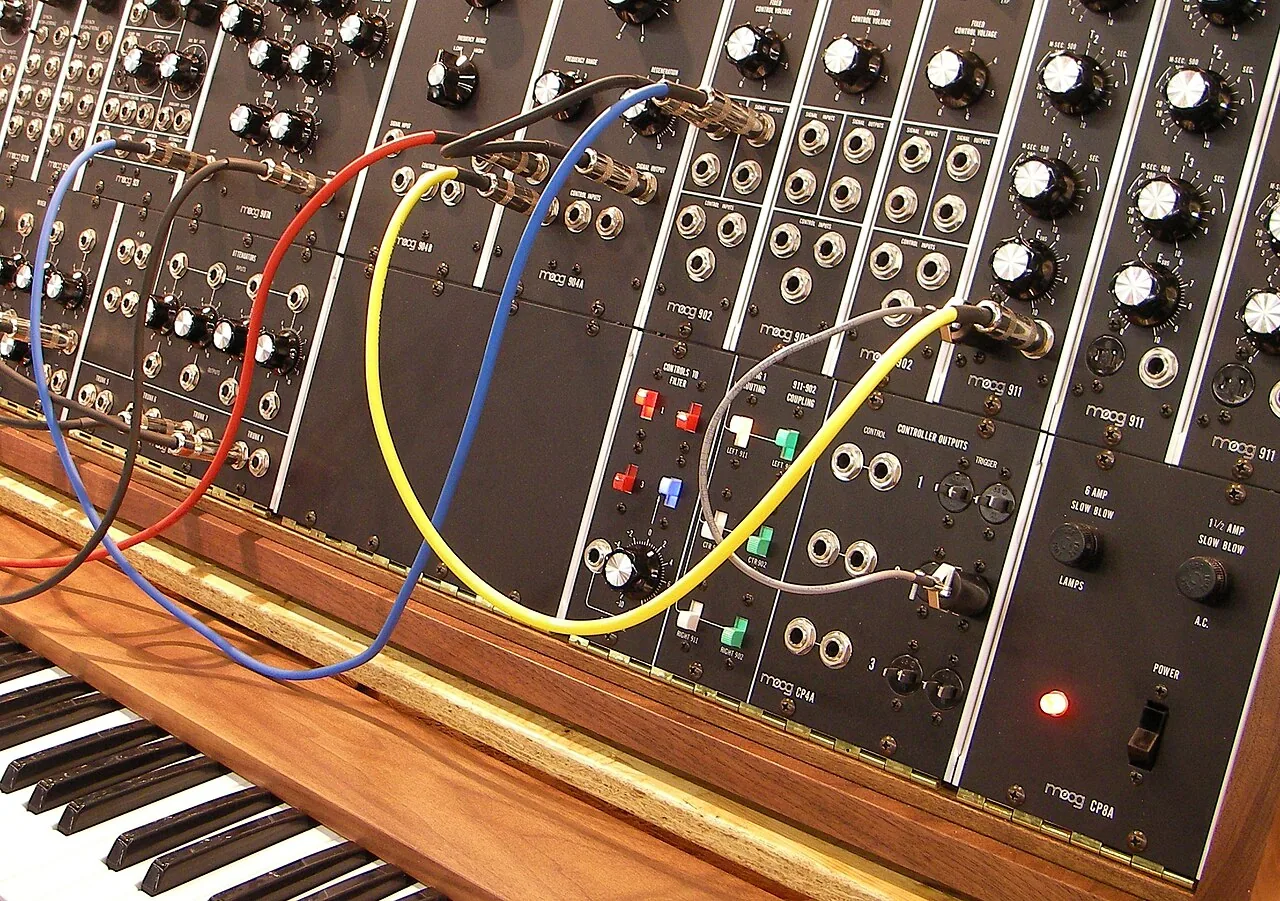
Begin with a spectrum
A harmonically rich oscillator gives the filter material to shape. Saw, square, pulse, noise, and sampled sources each respond differently.
Cutoff chooses the horizon
The cutoff frequency sets where attenuation begins. Moving it over time can turn a static waveform into a phrase with attack, breath, distance, and direction.
Resonance creates emphasis
Feedback around the filter highlights frequencies near cutoff. At high settings, some filters begin to oscillate and become sound sources in their own right.
Synthesizer filter guide: begin with the sound before the cutoff
A bright sawtooth enters the filter. Turn the cutoff down and its edge softens, then its upper detail disappears, then only a dark fundamental region remains. The oscillator has not changed pitch. The filter has redrawn which parts of its spectrum reach the amplifier.
This synthesizer filter guide treats that movement as a musical act rather than a repair applied after sound generation. Cutoff, resonance, envelope, key tracking, and modulation can articulate a phrase as clearly as notes and rhythm.
The source decides what the filter can reveal
A sine wave contains one principal frequency, so a low-pass filter above that frequency has little harmonic material to remove. A square wave begins with strong odd harmonics; a sawtooth contains a broad series; noise spreads energy across many frequencies. The same cutoff setting therefore produces very different audible changes.
Before designing a patch, listen with the filter open and resonance low. That baseline reveals whether brightness comes from waveform, oscillator combination, distortion, or noise. A filter cannot reveal harmonics the source does not contain, although high resonance or nonlinear circuitry may add their own colour.
Cutoff is a boundary, not a brick wall
A low-pass filter attenuates frequencies above cutoff. High-pass does the inverse, band-pass keeps a region, and notch rejects one. The slope describes how quickly attenuation increases beyond the cutoff, often expressed in decibels per octave. A steeper slope usually separates regions more strongly, but circuit behavior near the boundary matters too.
Use one sustained note and compare filter types at matched level. A low-pass sweep removes brightness; high-pass can thin the fundamental region; band-pass can isolate a nasal or vocal-like band. Then return to the phrase. A static spectrum comparison is only the beginning because most musical filters move over time.
Resonance turns the boundary into a voice
Resonance feeds energy around the cutoff frequency, creating a peak that makes the moving boundary easier to hear. Moderate resonance can emphasize a vowel-like contour or pick out a harmonic. Higher settings can reduce perceived body elsewhere and create a whistle as cutoff moves.
Some designs reach self-oscillation: the filter produces a sine-like tone without an oscillator input. That behavior depends on topology and implementation. Increase feedback cautiously because resonance can create sharp level peaks. The Bob Moog Foundation’s filter overview includes demonstrations of cutoff, resonance, and self-oscillation in classic instruments.
An envelope gives every note a spectral gesture
Set a low cutoff, moderate resonance, and positive envelope amount. A short attack raises the cutoff after each key press; decay lets it fall toward the sustain level; release controls the motion after the key rises. A plucked patch often uses a fast attack and noticeable decay so brightness arrives first and recedes while amplitude continues.
Envelope amount is a depth, not a replacement cutoff. If the base cutoff is already open, positive modulation may have little audible room to travel. If it is too low, the attack can disappear. Velocity can scale depth so harder playing opens more spectrum, linking touch to timbre rather than merely to volume.
LFO and key tracking solve different movement problems
An LFO repeats. Slow modulation can create a broad sweep; faster rates become tremulous and eventually enter the audible-frequency range on instruments that allow it. Synchronization can place the cycle against tempo, but a mathematically aligned sweep may still begin at an unhelpful phase.
Key tracking moves cutoff with played pitch. Without it, a fixed cutoff may leave low notes bright and high notes dull because the harmonic series shifts upward while the filter boundary stays still. Partial tracking can preserve a family resemblance across the keyboard without making every note spectrally identical.
Build one patch by changing one relationship at a time
- Choose one harmonically rich oscillator and open the filter.
- Lower cutoff until the desired body remains.
- Add resonance only far enough to hear the boundary.
- Shape a short envelope and adjust its amount.
- Test low, middle, and high notes before adding key tracking.
- Add LFO or performance control only after the core gesture works.
Record the baseline before adding distortion, drive, or multiple modulation routes. If the patch becomes thin, mute modulation and lower resonance before replacing the oscillator. If the sweep vanishes, check base cutoff and envelope amount. Troubleshooting follows the signal path more quickly than turning every knob.
Drive changes the filter before cutoff moves
Increase the signal entering some filters and the circuit or model begins to saturate. New harmonics can appear, peaks can compress, and resonance may respond differently. This is why input level belongs in any comparison between filter types. Matching only the output volume does not guarantee that both filters received the same stimulus.
Build the clean patch first, then raise drive and listen at several cutoff positions. If brightness returns after a low-pass sweep, it may come from saturation created inside or after the filter. That can be the desired sound, but it should be understood as generation as well as subtraction.
Topology matters, but labels do not finish the listening
Ladder, state-variable, diode-ladder, transistor, OTA, digital, and modeled filters can differ in slope, resonance behavior, drive, phase, and level compensation. Two instruments carrying the same family name need not respond identically. Compare them at matched input, cutoff region, resonance, and output level.
Continue to Music for listening and production stories or return to the Blog index. The filter becomes an instrument when its movement creates expectation, accent, release, and register, not when the patch merely contains a technically interesting circuit.
Keep following the subject
These pages pick up the mechanism, measurement, or source trail behind this story.