Why a drum has more than one pitch
Shell, head, tension, and room create a spectrum broader than a single note.
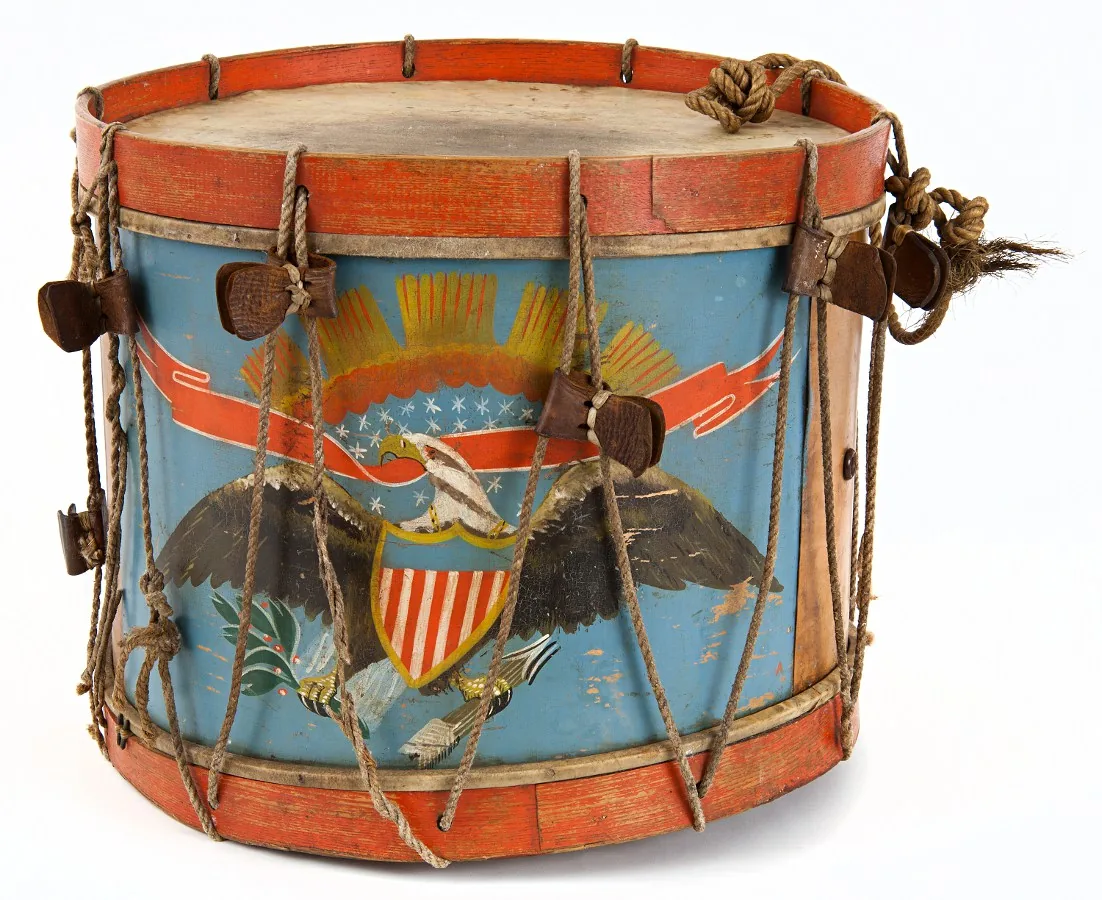
A cloud of modes
A circular membrane does not vibrate like a string. Many patterns overlap after a strike, producing a complex spectrum that the ear can interpret as pitch, noise, attack, and body.
Tension is tuning
Increasing head tension raises the dominant modes and changes response. Uneven tension can introduce beating or instability; deliberate tuning balances character with consistency.
The shell speaks too
The shell controls air volume and reflects energy between the heads. Depth, diameter, bearing edges, material, and damping change sustain and projection.
Why drums have more than one pitch begins with a moving surface
Strike the center of a drumhead and the membrane does not rise and fall as one rigid disc. Some regions move outward while others move inward, separated by lines that barely move. Each pattern has its own frequency, decay, and ability to couple with air, shell, second head, snares, and room.
That is why drums have more than one pitch. The ear receives a family of modes plus a short, noisy attack. Tuning changes their relationships, but a drum is not a string whose overtones line up in one simple harmonic series.
A circular membrane supports overlapping modes
The lowest mode moves most of the head in one broad pattern. Higher modes add nodal circles and diameters, dividing the surface into smaller regions of opposite motion. Their frequencies are not usually whole-number multiples of the fundamental, so the combined sound can suggest a pitch center without behaving like a piano note.
The physics is visible in slow-motion or modal diagrams, but it is also audible. Strike near the center and lower, more symmetrical modes receive strong energy. Move toward the edge and the balance changes. The attack, stick hardness, and listening distance affect which part of that mixture dominates.
Tension, diameter, and mass move the family together
Increasing membrane tension raises modal frequencies. A larger diameter tends to lower them, while greater mass per area also lowers them. Head construction, coating, thickness, and wear influence mass, damping, stiffness, and attack. One variable rarely changes tone without changing response or decay.
Even lug tension matters because local differences can split or destabilize modes. Tapping around the edge is a practical way to compare nearby regions, not proof that the entire membrane owns one exact note. Bring differences closer gradually and in small cross-pattern turns so the hoop and head remain seated.
The second head and enclosed air join the motion
A tom or snare has two membranes coupled through the air inside the shell. Move the batter head and the enclosed air drives the resonant head; that head pushes back. Their tuning relationship changes sustain, pitch movement, response, and the way energy leaves the drum.
The shell is not merely a passive container. It provides structure, reflects and radiates energy, and has its own resonances, although the heads and enclosed air often dominate the easily adjusted behavior. Bearing edges, hoop, mounting, damping, and contact with stands change boundary conditions around the membrane.
Snare wires turn part of the spectrum into noise
On a snare drum, the lower head drives wires against its surface. Their many contacts produce a bright, noisy response that can mask a clear pitch center. Wire tension, alignment, bed shape, lower-head tension, and damping determine whether the response is crisp, choked, loose, or sympathetic.
A buzz at one note may be sympathetic excitation from another instrument rather than a loose object. Mute the wires briefly, change the source note, and listen again. Do not tighten every component at once. The pattern of what starts and stops identifies the part of the system that deserves attention.
A tuning pass listens to zones, then to music
- Seat the head and bring lugs to low, even tension by hand.
- Use small cross-pattern turns rather than circling in one direction.
- Tap at equal distance from each lug and compare nearby regions.
- Strike the center and several off-center points at playing force.
- Repeat after the head settles, then test the drum with the kit or ensemble.
A tuner or spectrum display can track a returning peak, but the stick attack is brief and mode-rich. Keep microphone position, strike point, stick, and force consistent. A number is useful when it follows an audible change; it is not a command to force every lug tap onto one frozen frequency.
Timpani and tabla shape the modes more deliberately
Timpani use bowl geometry and membrane tension to create a stronger pitch impression, and players tune that center to musical notes. Tabla makers and players use loaded membranes whose central material changes modal relationships. These instruments show that “drum pitch” is not one universal acoustic condition.
Toms often favour a broad center and controlled decay. Bass drums may prioritize low impact and air movement. Snare drums combine body with wire noise. Compare each instrument by its musical job rather than applying one tuning recipe to every circular membrane.
Damping changes duration and balance, not only loudness
A gel, ring, cloth, hand, or internal muffler removes energy from some motions more effectively than others. The drum may seem lower or more focused because high, long-ringing modes fade, even when membrane tension has not changed. Place damping deliberately and compare center, edge, and ensemble sound.
Too much damping can hide uneven tuning without correcting it. First bring the head into a stable mechanical condition, then use damping to shape decay for the musical role. Record its position if the sound must be reproduced; moving a small piece toward the center can change the result noticeably.
The measurement has a boundary
The University of New South Wales paper on the physics of musical instruments provides technical context for modes and resonators. A real drum adds nonlinear strike behavior, imperfect boundaries, changing tension, room response, and a player who never hits exactly the same point twice.
Continue to Instruments for mechanism and repair stories or return to the Blog index. A drum becomes easier to tune once “pitch” is heard as an organized cluster of motions rather than a single number hiding beneath the attack.
Keep following the subject
These pages pick up the mechanism, measurement, or source trail behind this story.