Piano guide: from key to soundboard
A piano turns a small key movement into a controlled hammer strike, then lets strings, bridges, soundboard, dampers, pedals, frame, case, and room carry the result. This piano guide follows that mechanism, connects touch with listening, marks safe maintenance boundaries, and gives practical questions for repertoire and inspection.
Keys, hammers, strings, and soundboard
The mechanism follows the action from key to hammer, escapement, string, bridge, soundboard, and damper. Thousands of regulated relationships let the hammer fly free and return quickly. Touch is therefore mechanical information as well as musical gesture.
Key and action. A key pivots and lifts a sequence of levers that accelerates the hammer toward the string. Escapement releases the hammer before contact so it can rebound rather than block vibration. Backchecks catch returning hammers and repetition parts prepare another note. Regulation balances many dimensions; one screw rarely fixes an isolated complaint.
Hammer and voicing. Felt density, shape, wear, alignment, and strike point influence attack and spectrum. Repeated grooves can harden contact and change brightness or control. Voicing alters felt response after action and strings are in suitable condition. Needling or hardening hammers is specialist work with irreversible consequences.
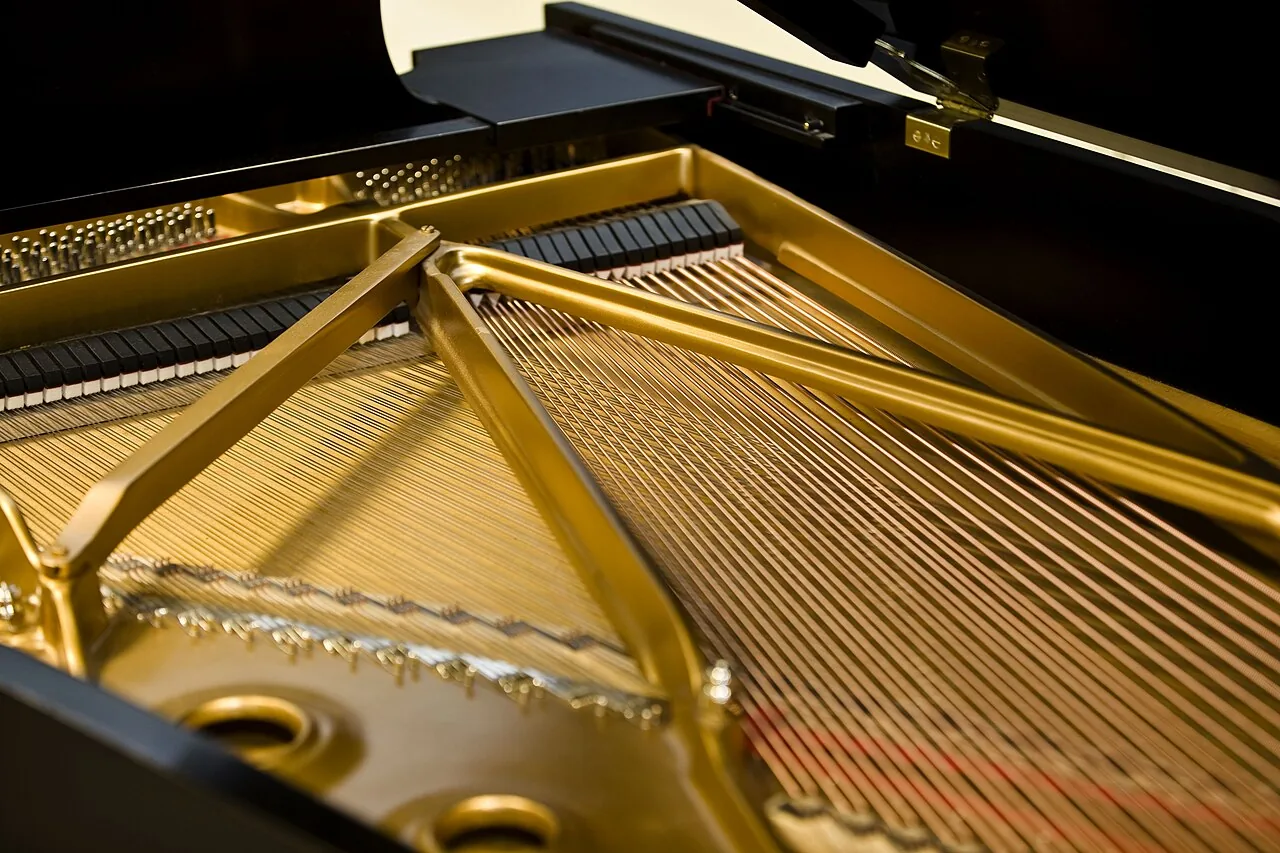
Strings and frame. Modern pianos use high-tension steel strings, with wound bass strings adding mass without extreme length. A cast frame carries much of the total tension while the wooden structure supports geometry. Unisons share one note and must agree closely for a stable tone. Broken strings and rust require assessment, not a generic replacement promise.
Bridge and soundboard. Strings drive bridges, which transmit vibration into the crowned wooden soundboard. Bridge pins define string direction and can reveal cracking or looseness. Soundboard ribs support shape and distribute motion. A visible crack alone does not predict musical severity without listening and structural inspection.
Dampers and pedals. Dampers stop most strings when keys rise, while the sustain pedal lifts them to allow resonance. The soft pedal changes action or string engagement differently on grand and upright designs. A sostenuto pedal selectively sustains held notes on instruments equipped with it. Pedal noise, lost motion, and incomplete damping need regulation.
Tuning system. Tuning pins hold string tension in the pinblock, and a technician sets temperament and unisons. Equal temperament is a framework, while octave stretch responds to string inharmonicity. Room temperature and humidity influence pitch and structure. A simple frequency table cannot replace a full piano tuning.
| Piano system | Function in the action | Touch or condition question |
|---|
| Action | Transfers key motion | Escapement, repetition, regulation |
| Hammer | Strikes strings | Felt shape, density, alignment |
| Strings and frame | Create and hold tension | Unisons, bass winding, structural load |
| Bridge and soundboard | Radiate string energy | Crown, ribs, bridge pins |
| Dampers and pedals | Control sustain | Timing, lift, selective resonance |
| Pinblock and pins | Hold tuning | Torque and long-term stability |
Playing and critical listening
Playing the piano joins attack, balance, voicing, pedal, release, register, and room. A pianist controls hammer speed before contact but cannot reshape a sustained string directly afterward. Listening must reach beyond the keybed toward resonance and decay.
Tone and touch. Key speed influences hammer speed and therefore attack and loudness. Pressing harder after the hammer has escaped cannot increase that note's sound. Control comes from coordinated motion, timing, and release. Practise repeated dynamics while listening at a distance from the keyboard.
Layering voices. Piano texture often requires melody, bass, and inner parts at different levels. Balance comes from touch distribution, articulation, register, and pedal rather than one louder hand. Play voices separately, then combine without losing their direction. Recordings can reveal a buried line that feels prominent under the fingers.
Pedal clarity. Sustain pedal connects harmonies through sympathetic resonance but can blur bass and changes. Half-pedal and timed changes depend on instrument and acoustic. Listen to the decay rather than following foot habit. Pedal markings are starting information, not identical mechanical depths on every piano.
Repetition and release. Fast repetition depends on action design, regulation, key return, and economical movement. A note that fails only softly may indicate a different issue from one that fails quickly. Clean releases shape rhythm even in legato texture. Do not diagnose regulation solely from one repertoire passage.
Room and lid. A grand lid changes projection; an upright reflects sound from wall and case. Hard rooms extend brightness and decay, while soft furnishings absorb selected bands. Move the listening position before changing voicing conclusions. Audience, curtains, and stage placement can alter balance.
- Listen for control at the softest practical dynamic.
- Balance melody, bass, and inner voices separately before combining.
- Change pedal by ear in the real acoustic.
- Record from the room rather than judging only at the bench.
- Test repetition and release with more than one musical texture.
Care, maintenance, and safe boundaries
Routine care separates dusting and environment records from tuning, regulation, voicing, restringing, soundboard, bridge, pinblock, and structural work. Large string tension and heavy components make improvised repair unsafe and expensive.
Environment. Track humidity and temperature rather than reacting to one day. Rapid or seasonal swings affect wood, tuning, action centers, and soundboard geometry. Keep the piano away from direct heat, water, and uncontrolled exterior exposure. A technician can advise suitable environmental management for the building.
Cleaning. Dust keys and finished surfaces with compatible dry or lightly controlled methods. Do not introduce liquid between keys or into action and strings. Interior cleaning around dampers, hammers, and strings requires safe technique. Finish products should match the maker's material and condition.
Tuning and service. Tuning frequency depends on use, environment, pitch drift, and institutional needs. A service visit may reveal regulation, voicing, string, pedal, or structural work separately. Keep dated reports and pitch records. Moving or large climate changes may justify a settling period before final work.
Moving safety. Pianos are heavy, top-heavy, and vulnerable at legs, pedals, casters, and action. Grand pianos require proper disassembly and equipment for transport. Floors, stairs, doors, and destination climate belong in the plan. Use experienced piano movers rather than general lifting improvisation.
- Track environment and keep the piano away from direct heat or water.
- Keep liquids and household sprays out of keys, action, and strings.
- Use piano technicians for tuning, regulation, voicing, and structural diagnosis.
- Use experienced movers with suitable equipment.
- Keep dated records of pitch, service, moves, and major climate events.
History and evolution
The Met's essay on Viennese pianos anchors this outline in dated instruments; the general history of the piano supplies wider context. Together they show changes in compass, action, stringing, and case as repertoire and public performance developed.
Cristofori. Bartolomeo Cristofori developed early hammer pianos in Florence around 1700. The Met preserves a Cristofori piano dated 1720 among the oldest surviving examples. Hammer action offered dynamic response unlike plucked harpsichord mechanisms. The earliest instruments differed in compass, frame, action, and power from later pianos.
Eighteenth-century diversity. German, English, and Viennese makers developed distinct actions and tonal responses. Composers encountered instruments with lighter frames, smaller compasses, and varied pedals or knee levers. No single fortepiano represents the whole century. Historically informed performance begins with the instrument type and place.
Nineteenth-century expansion. The Met notes growth from about five octaves late in the eighteenth century to seven octaves by mid-nineteenth. More strings, stronger bracing, larger cases, and public halls increased power. Iron framing and cross-stringing developed through several makers and patents. Industrial growth changed both construction and domestic access.
Grand and upright forms. Grand action preserves horizontal layout and repetition geometry, while upright designs save floor space. Nineteenth-century upright development brought pianos into more homes and schools. Different forms solve projection and service access differently. Size alone does not determine condition or musical value.
Recording and modern use. Player pianos, recording, broadcasting, amplified stages, digital instruments, and software changed access and repertoire. Acoustic pianos remained central in education, concert, jazz, and domestic music. Technicians adapted service to changing materials and expectations. Digital keyboards are related interfaces, not mechanically identical pianos.
Repertoire and musical context
Piano work moves between solo, chamber, song, concerto, jazz, popular music, teaching, rehearsal, and the studio. The note frequency reference helps separate pitch math from piano tuning practice, while the Instrument Atlas compares hammered strings with other sound systems.
Solo and chamber. Keyboard repertoire ranges from Baroque works adapted to piano through Classical, Romantic, modern, and new music. Chamber playing demands balance with strings, winds, and voices. Instrument, room, and lid position alter partnership. Historical works can reveal action and register differences.
Jazz and popular practice. Jazz pianists shape time, voicing, harmony, comping, bass, and improvisation across acoustic and electric contexts. Popular arrangements often combine piano with dense amplified tracks. Register and attack must leave mix space. Style knowledge matters more than one universal bright or mellow tone.
Teaching and rehearsal. Pianos support theory, ear training, choir rehearsal, composition, and accompaniment. Reliable action and tuning affect learning even when the instrument is not a concert grand. A teacher needs consistent repetition and controllable soft playing. Service priorities should follow actual use.
Buying, documentation, and inspection
Before the complete play-through, record the piano's identity, environment, and tuning history. A polished cabinet can hide action wear or structural trouble. A technician's evaluation should precede purchase, major move, or confident repair estimate.
Identity and history. Record maker, model, serial, dimensions, location history, moves, repairs, and service documents. Serial references can suggest dates but need maker-specific interpretation. Ask about water, heat, storage, and major rebuilding. Cabinet appearance is not a condition report.
Tuning stability. Have a technician assess pitch, pin torque, unisons, strings, bridges, and pinblock behavior. A freshly tuned piano may still drift if structural support is weak. Do not judge stability from one chord. Service history and environmental pattern matter.
Action and keyboard. Play every key softly, loudly, repeatedly, and with pedals. Check spacing, level, friction, repetition, hammer alignment, damping, and noise. Wear can be regulated only within remaining adjustment and part condition. Request an estimate that separates regulation from replacement.
Soundboard and bridges. Inspect accessible board, ribs, bridges, pins, and case joints with proper light. Listen for buzzes, false beats, weak areas, and uneven sustain. Cracks vary in cause and consequence. A technician should connect visual evidence with tone and structure.
Move and total plan. Price transport, access, climate preparation, tuning, regulation, repair, and future service separately. Confirm floor loading and placement where relevant. A low purchase price can accompany a large restoration need. Decide from total musical and logistical requirements.
| Area | Method | Concern |
|---|
| Tuning stability | Technician assessment and records | Rapid drift or weak pin support |
| Action | Every key at several dynamics | Failure, friction, noise, exhausted adjustment |
| Strings and bridges | Visual and listening check | Rust, loose pins, broken or false strings |
| Soundboard | Structure plus tone | Buzzes, loose ribs, serious movement |
| Move and environment | Route and destination plan | Unsafe access or uncontrolled climate |
- Can documents support maker, model, date, moves, and repairs?
- Does tuning stability justify the intended use and service budget?
- Can every key repeat and speak across useful dynamics?
- What structural, string, bridge, damper, and pedal work is recommended?
- What will transport, environment, tuning, and regulation cost together?
Listening to a piano without confusing touch, tuning, and room
A piano comparison needs time to settle. Rapid temperature or humidity changes affect wood, action centers, strings, and soundboard behavior. Note the room condition, when the instrument was last tuned, and whether it has just been moved. Play at a moderate dynamic before testing extremes. A cold action or newly changed environment can make a first impression unreliable, especially when the next piano is heard in another room.
Use the same short passage for touch and tone. Include repeated notes, a quiet chord, a scale through the break, and one sustained bass note. Keep bench height and distance comfortable. The key initiates the hammer through the action; pressing harder after escapement cannot add energy to a hammer already in flight. Describe where control changes during the key travel, whether repetition resets cleanly, and whether neighboring keys feel alike.
Separate tuning from voicing. Tuning sets frequency relationships among strings. Voicing changes hammer contact and tonal balance, while regulation adjusts action geometry and timing. A bright note may be in tune, and an unstable unison may still have a soft hammer. Hold the sustain pedal only when the test calls for resonance; otherwise sympathetic strings can hide the source. Record the key, dynamic, pedal state, and whether the issue appears on single notes or chords.
The transition between bass, tenor, and treble can reveal design and condition. Play a chromatic line slowly through string changes and listen for abrupt shifts in color, sustain, or level. Some change is normal because string length, winding, bridge position, and soundboard coupling vary. The question is whether one note breaks the musical line or whether an entire register has a consistent character. Compare from the bench and several metres away, since the player hears more action and direct attack.
Repeated-note testing should be musical and restrained. Choose one middle-register key, repeat it at a steady moderate speed, then compare its neighbors. Note missed strikes, double strikes, sluggish return, or an unusual key height. Do not force speed after the mechanism begins to fail. The exact tempo, dynamic, and pedal state help a piano technician reproduce the behavior. A vague report that repetition is slow offers little guidance.
Pedals change more than volume. The right pedal lifts dampers and joins sympathetic resonance; the soft pedal changes the striking relationship according to grand or upright design; the middle pedal may sustain selected notes or operate a practice system. Test each at low speed and listen for noise, incomplete damping, and consistent travel. Pedal adjustments connect to trapwork and internal mechanisms, so a loose or scraping pedal should be documented rather than tightened blindly.
Frequently asked questions
Why does a piano have more than one string per note?
Many middle and treble notes use unison groups to increase energy and tonal complexity. The strings must be tuned together closely; bass notes often use one or two heavier wound strings.
Is every modern piano tuned exactly to a frequency table?
A reference pitch and temperament guide the work, but technicians stretch octaves because real strings are inharmonic. Instrument scale, condition, room, and musical use affect the final tuning.
How often should a piano be serviced?
There is no universal interval. Use, climate stability, pitch change, action condition, and performance expectations matter. A technician can set a schedule after observing the instrument across time.
Can a piano guide tell whether a soundboard crack is serious?
A piano guide can explain why cracks occur, but seriousness depends on movement, crown, ribs, bridges, buzzes, and overall structure. A technician must inspect and listen to the actual instrument.
Why do some keys repeat better than others?
Regulation, friction, hammer return, springs, repetition parts, key balance, and wear can differ note by note. Soft and rapid tests help identify the pattern for service.
Is an old piano automatically valuable?
Age alone does not establish musical, historic, or market value. Maker, model, rarity, provenance, originality, condition, restoration quality, size, and demand all matter.
What should be checked before moving a piano?
Confirm dimensions, weight, stairs, turns, doors, floors, insurance, destination climate, and appropriate movers. Plan post-move tuning and any settling period with a technician.
Conclusion
A piano rewards inspection that joins mechanism, structure, sound, environment, and musical purpose. Play every note, listen at several dynamics, test pedals and repetition, and obtain a technician's report before a major decision. Its condition and response must support the work expected of it.