Violin guide: from bow to body
A violin sustains sound because bow hair repeatedly grips and releases a string while the bridge and carved body move air. The left hand changes speaking length; the bow changes energy, color, and articulation. This violin guide connects those mechanics with practice, care boundaries, documented making history, repertoire, and inspection.
Strings, bow, bridge, and carved body
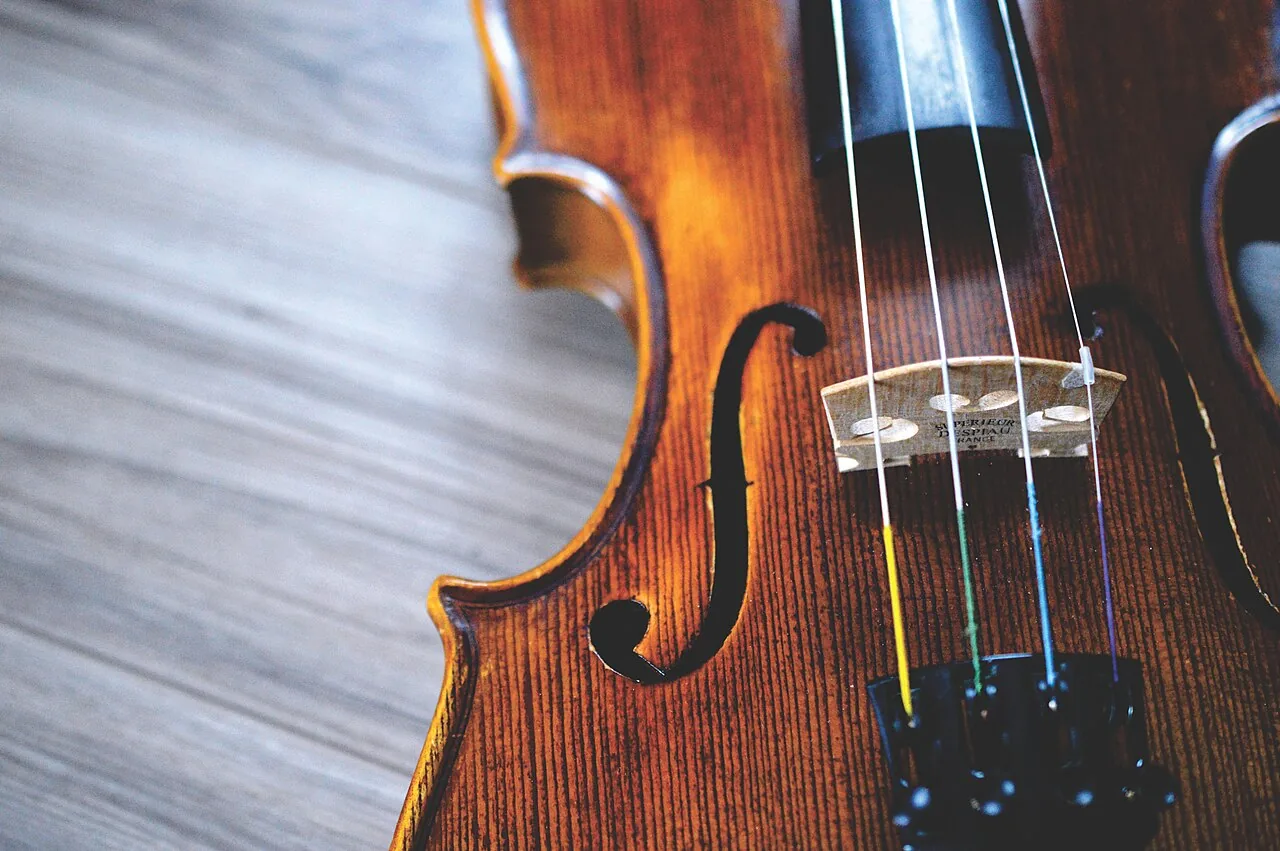
The mechanism follows vibration from string through bridge, top, bass bar, soundpost, ribs, back, and air cavity. Bow contact keeps feeding energy. Small setup changes interact, which is why bridge, post, string, and neck decisions belong to skilled luthiers.
String and stop length. Pitch depends on vibrating length, tension, and mass between bridge and nut or stopped finger. Four strings offer overlapping registers and different response. String choice changes tension and spectrum within setup limits. The left hand controls pitch without frets.
Bow interaction. Rosined hair alternately grips and releases the string in Helmholtz-like motion. Speed, weight, and contact point must remain in a workable relation. Too much pressure can crush motion; too little can fail to engage. Bow condition and player coordination both matter.
Bridge. The fitted bridge supports strings and filters motion into the top. Its feet must match the arch and remain properly positioned. Thickness, cut, curvature, and height affect response and playability. A falling or warped bridge can damage the top or setup.
Bass bar and soundpost. The bass bar is glued beneath the top; the soundpost stands by friction between top and back. Together they influence support and vibration distribution. Post position and fit are sensitive and structurally important. Only a trained luthier should move or fit the post.
Body and air. Spruce top, maple back and ribs, arching, graduations, f-holes, varnish, and enclosed air interact. The body radiates far more effectively than a string alone. Age or wood species does not guarantee quality. Repairs and setup can dominate a brief comparison.
| Violin system | Function in sound production | Bowing or inspection question |
|---|
| String | Creates bowed vibration | Length, tension, material |
| Bow | Feeds energy | Hair, rosin, speed, weight |
| Bridge | Transfers and filters | Fit, cut, curvature, height |
| Top and bass bar | Radiate and support | Arching, graduations, condition |
| Soundpost | Couples top and back | Fit, position, structural role |
| Room | Completes projection | Distance, reflection, ensemble |
Playing and critical listening
Playing the violin joins bow speed, weight, contact point, sounding point, left-hand intonation, shifting, vibrato, articulation, posture, and listening. A beautiful isolated note is not enough; transitions and balance give the line grammar.
Open-string bowing. Open strings remove left-hand pitch so the player can hear attack, path, and release. Use slow bows to map contact point and sound continuity. Watch the bridge without twisting posture. Then transfer the same bow to stopped notes.
Intonation. Finger placement is guided by ear, hand frame, key, harmony, and neighboring notes. A tuner can show sustained pitch but not phrase function. Practise drones, scales, and double stops at moderate speed. Vibrato should not hide an uncertain center.
Shifting. A shift coordinates release, guide motion, arrival, and renewed balance. Thumb and finger should travel without squeezing. Hear the destination before moving. Practise rhythm and bow separately before combining.
Vibrato. Vibrato varies pitch and color around a chosen center through controlled arm, wrist, or finger motion. Width and speed follow style and phrase. Continuous identical vibrato can flatten expression. Develop stable straight tone first.
Articulation and ensemble. Detaché, legato, martelé, spiccato, sautillé, and other strokes use different bow mechanics. Section playing requires matched contact, length, bowing, and release. Chamber playing needs independent color and listening. Notation is completed by style and acoustics.
- Practise bow speed, weight, and contact point as a relationship.
- Establish pitch center before adding vibrato.
- Hear the destination before shifting.
- Match articulation and release with the ensemble.
- Record from the room to judge projection and balance.
Care, maintenance, and safe boundaries
Routine care includes loosening the bow, wiping rosin, checking seams visually, changing strings carefully, and controlling case environment. Soundpost, bridge fitting, cracks, neck angle, pegs, fingerboard, and bow repair require a luthier or bow specialist.
Rosin and wiping. Apply enough rosin for reliable grip without creating excessive dust. Wipe strings and varnished surfaces gently after playing. Avoid solvents and household polish. Built-up rosin near the bridge may require luthier cleaning.
Bow storage. Loosen hair after use so the stick is not held under playing tension. Hold by the frog and avoid touching hair. Check tip, frog, screw, winding, and straightness. Rehair and structural repair belong to bow specialists.
Strings and bridge watch. Change one string at a time to help retain bridge and soundpost conditions. Bring pitch up gradually and watch bridge alignment. A leaning bridge should be corrected safely before it warps. Stop if seams open or the post falls.
Case environment. Use a protective fitted case and avoid heat, vehicles, water, and rapid climate shifts. Humidity management must suit region and instrument. Do not store shoulder rests where they press the violin. Inspect after travel before tuning aggressively.
- Loosen the bow and wipe rosin after playing.
- Change strings one at a time and watch bridge alignment.
- Keep the violin in a fitted case away from heat and water.
- Stop if a seam opens, bridge leans badly, or soundpost falls.
- Use luthiers and bow specialists for structural and setup work.
History and evolution
The Met's essay on Nicolò Amati and Antonio Stradivari anchors the maker history in documented workshops. The general violin history supplies wider context without relying on secret-varnish legends.
Early sixteenth century. The violin family emerged in northern Italy during the early sixteenth century from several bowed-string traditions. Early images and surviving instruments show developing forms. Violin, viola, and cello roles changed with ensembles. No single maker invented every defining feature.
Amati workshop. Andrea Amati established an influential Cremonese workshop in the sixteenth century. Nicolò Amati lived from 1596 to 1684 and trained apprentices in a major European atelier. Amati forms influenced later makers. Attribution depends on expert evidence, not outline alone.
Stradivari. Antonio Stradivari lived from 1644 to 1737 and worked in Cremona. The Met describes long-pattern experiments and a grand pattern around 1700. His shop also built violas, cellos, guitars, and other strings. Reputation grew further in the late eighteenth century.
Modernization. Many seventeenth- and eighteenth-century violins were later altered for changing range, projection, and playing demands. Necks, fingerboards, bass bars, bridges, and strings changed. The Met notes modernization of surviving Stradivari examples. Baroque and modern setup should be named explicitly.
Chinrest and later practice. Louis Spohr is commonly associated with introducing the chinrest around 1820. Steel strings, standardized orchestras, recording, and global teaching later changed practice. Historical instruments continued to be adapted and restored. Conservation weighs evidence against modern use.
Repertoire and musical context
Violin playing extends across solo, chamber, orchestra, opera, folk traditions, dance, jazz, studio work, education, and historically informed performance. Use the chromatic tuner for a separate pitch trend, then return to the Instrument Atlas to compare bowed strings with other resonators.
Solo and chamber. Bach, Mozart, Beethoven, Brahms, and later composers developed demanding solo and chamber languages. Intonation, articulation, and balance change with ensemble and room. Sonata playing is a partnership with keyboard, not accompanied solo display. Instrument setup should support required response.
Orchestra and opera. Section players coordinate bowing, articulation, rhythm, color, and dynamic shape across many desks. Leadership and visual communication matter. Pit conditions alter projection and hearing. A violin that feels large alone may blend differently in section.
Folk, jazz, and contemporary work. Fiddle traditions use specific tunings, bow patterns, ornaments, repertoire, and social contexts. Jazz adds improvisation and amplified settings; contemporary work may use extended techniques. Learn style from practitioners and recordings. Do not reduce traditions to a generic rustic sound.
Buying, documentation, and inspection
Use good light and establish provenance before checking seams, cracks, arching, neck, bridge, pegs, fingerboard, setup, and bow. Sound must be tested after structural condition, not used to excuse an unsupported attribution or unstable repair.
Provenance and label. Treat an internal label as evidence to investigate, not proof of maker. Gather certificates, receipts, repair records, photographs, and ownership history. Expert attribution may require construction study and dendrochronology. A famous printed name is easy to copy.
Seams and cracks. Inspect top, back, ribs, corners, saddle, f-holes, and pegbox under angled light. Open seams may buzz and worsen; repaired cracks vary greatly. Soundpost-area and bass-bar cracks deserve special attention. Repair quality matters as much as visibility.
Neck and fingerboard. Check projection, alignment, neck root, fingerboard scoop, wear, nut, and string clearance. Poor geometry affects response and playability. Planing or neck work changes several relationships. A luthier should measure before estimating.
Bridge, pegs, and setup. Check bridge fit and warp, peg movement, tailpiece, afterlength, fine tuners, post stability, and strings. Setup parts are replaceable but costs add up. Pegs should turn smoothly and hold without force. Do not move the post for a quick tone experiment.
Bow. Sight the stick, inspect head, frog, screw, hair, winding, and repairs. Test stiffness, balance, tracking, and response with the violin. A valuable violin does not make an unsuitable bow useful. Obtain separate bow expertise for fine examples.
| Area | Method | Concern |
|---|
| Provenance | Documents and expert opinion | Label-only attribution |
| Body | Seams, cracks, arching, repairs | Open joints or unstable repair |
| Neck and board | Measured geometry and wear | Poor projection or deep grooves |
| Setup | Bridge, post, pegs, strings | Warp, slipping, unsafe position |
| Bow | Structure and playing test | Cracks, twist, failed screw |
- What provenance survives beyond the label?
- Are seams, cracks, arching, neck, and pegbox stable?
- Do bridge, post, pegs, fingerboard, and strings form a sound setup?
- What repairs and modernization are documented?
- Does the bow suit the instrument and player independently?
A final ensemble trial should include open strings, a scale, soft attacks, shifts, double stops, and a short passage in the intended room. Listen near the player and several metres away because direct bow noise and projected body sound change with distance. Record strings, bridge condition, bow, setup, humidity, and repertoire. If response changes sharply across strings or dynamics, let a luthier connect the observation with geometry before altering the post or bridge.
A violin observation that separates player, bow, setup, and room
Let the violin and bow settle in the room before comparing response. Record string set, recent work, room condition, bow, rosin, and listener distance. Begin with open strings at moderate dynamic. Open notes remove left-hand intonation from the first check and make attack, bow path, string crossing, wolf behavior, and release easier to hear.
Bow speed, contact point, and applied weight work together. Change only one while drawing a full bow on one open string. Moving toward the bridge usually requires a different balance than playing over the fingerboard. Scratch, whistle, weak core, or delayed start may come from that relationship rather than a defect. Use a mirror or teacher's view to check path before changing setup.
Compare strings with the same bow lane and dynamic. Listen for response at the start, body of the note, decay after release, and transition across crossings. Different strings naturally have different color and tension. A concern is more specific: one string repeatedly fails at a familiar contact point, one note produces a persistent buzz, or a register changes after recent work.
Intonation work should have musical context. A tuner can establish open-string or sustained reference, but scale degree, harmony, leading motion, and ensemble affect where a note belongs. Use drones and slow scales, then test the same pitch inside a phrase. Record whether the issue is one finger pattern, one position, or a broader hand-frame problem. Vibrato should not be used to conceal an uncertain center.
Shifting tests need relaxed repetition. Hear the arrival pitch, release unnecessary finger pressure, move with a guide where appropriate, and restore balance at the destination. Separate the left-hand motion from the bow before combining them. If one region feels physically blocked or strings sit unusually high, stop increasing force. A luthier can measure neck, fingerboard, nut, bridge, and projection relationships.
The bridge should stand in the correct position with feet fitted to the top and its back face aligned according to professional setup. Tuning can pull the upper edge forward. Players should watch for obvious lean while bringing strings up gradually, but correction requires care. Do not squeeze the body, move the bridge sideways, or continue if the bridge is severely warped, cracked, displaced, or unstable.
The soundpost is held by friction inside the body. Its position and fit affect structure and response, and it can fall when string tension is removed. Never move it through an f-hole for a quick tone experiment. If the post falls, strings should be loosened safely and the instrument taken to a luthier. A photograph through the f-hole can document location only when made without touching varnish or internal parts.
Frequently asked questions
Why does the violin have no frets?
Continuous finger placement allows flexible intonation, glissando, and expressive pitch, but demands trained hearing and hand mapping. Key, harmony, neighboring notes, and ensemble context guide the center.
How much rosin should be used?
Enough for clean engagement without clouds of dust or a glassy slipping sound. Hair, humidity, rosin type, and playing affect frequency. More is not always better.
Can a violin guide explain soundpost adjustment?
A violin guide can explain the post's role, but moving or fitting it risks sound and structure. Only a trained luthier with proper tools should perform the work.
Why does the bridge lean after tuning?
String friction can pull the bridge top toward the fingerboard as pitch rises. Monitor alignment during string changes and ask a luthier to correct it safely before warping develops.
Are old violins better than new ones?
No. Maker, model, materials, construction, condition, repairs, setup, bow, player, and room matter. Excellent and poor instruments exist at many ages.
Should vibrato be used on every note?
Vibrato is a phrasing and color choice, not a required coating. Width, speed, onset, and absence should follow style, harmony, ensemble, and musical direction.
What must a used-violin inspection include?
Check provenance, seams, cracks, neck geometry, fingerboard, bridge, soundpost stability, pegs, strings, repairs, bow, case, and playing response with an independent luthier.
Conclusion
A violin should be judged as a linked system of bow, strings, bridge, setup, carved body, room, and player. Preserve structural evidence, keep routine care gentle, and ask specialists to handle the post, bridge, cracks, neck, pegs, and bow. Musical response and documented condition belong in the same decision.